Archives for category: Buddhism

Almost everyone schoolboy these days has heard of the Lorentz transformations which replace the Galileian transformations in Special Relativity. They are basically a means of dealing with the relative motion of two bodies with respect to two orthogonal co-ordinate systems. Lorentz first developed them in an ad hoc manner somewhat out of desperation in order to ‘explain’ the null result of the Michelson-Morley experiment and other puzzling experimental results. Einstein, in his 1905 paper, developed them from first principles and always maintained that he did not at the time even know of Lorentz’s work. What were Einstein’s assumptions?

  1. 1.  The laws of physics take the same form in all inertial frames.
  2. 2.  The speed of light in free space has the same value for all observers in inertial frames irrespective of the relative motion of the source and the observer.

As has since been pointed out, Einstein did, in fact, assume rather more than this. For one thing, he assumed that ‘free space’ is homogeneous and isotropic (the same in all directions) (Note 1). A further assumption that Einstein seems to have made is that ‘space’ and ‘time’ are continuous ─ certainly all physicists at the time  assumed this without question and the wave theory of ele tro-magnetism required it as Maxwell was aware. However, the continuity postulate does not seem to have played much of a part in the derivation of the equations of Special Relativity  though it did stop Einstein’s successors from thinking in rather different ways about ‘Space/Time’. Despite everything that has happened and the success of Quantum Mechanics and the photo-electric effect and all the rest of it, practically all students of physics think of ‘space’, ‘time’ and electro-magnetism as being ‘continuous’, rather than made up of discrete bits especially since Calculus is primarily concerned with ‘continuous functions’. Since nothing in the physical world is continuous, Calculus is in the main a false model of reality.

Inertial frames, which play such a big role in Special Relativity, as it is currently taught, do not exist in Nature : they are entirely man-made. It was essentially this realisation that motivated Einstein’s decision to try to formulate physics in a way that did not depend on any particular co-ordinate system whatsoever. Einstein assumed relativity and the constancy of the speed of light and independently deduced the Lorentz  transformations. This post would be far too long if I went into the details of Special Relativity (I have done this elsewhere) but, for the sake of the general reader, a brief summary can and should be given. Those who are familiar with Special Relativity can skip this section.

The Lorentz/Einstein Transformations     Ordinary people sometimes find it useful, and physicists find it indispensable, to locate an object inside a real or imaginary  three dimensional box. Then, if one corner of the imaginary box (e.g. room of house, railway carriage &c.) is taken as the Origin, the spot to which everything else is related, we can pinpoint an object by giving its distance from the corner/Origin, either directly or by giving the distance in terms of three directions. That is, we say the object is so many spaces to the right on the ground, so many spaces on the ground at right angles to this, and so many spaces upwards. These are the three co-ordinate axes x, y and z. (They do not actually need to be at right angles but usually they are and we will assume this.)

Also, if we are locating an event rather than an object, we will need a fourth specification, a ‘time’ co-ordinate telling us when such and such an event happened. For example, if a balloon floating around the room at a particular time, to pinpoint the event, it would not be sufficient to give its three spatial co-ordinates, we would need to give the precise time as well. Despite all the hoo-ha, there is nothing in the least strange or paradoxical about us living in a ‘four-dimensional universe’. Of course, we do done  : the only slight problem is that the so-called fourth dimension, time, is rather different from the other three. For one thing, it seems to only have one possible direction instead of two; also the three ‘spatial’ directions are much more intimately connected to each other than they are to the ‘time’ dimension. A single unit serves for the first three, say the metre, but for the fourth we need a completely different unit, the second, and we cannot ‘see’ or ‘touch’ a second whereas we can see and touch a metre rod or ruler.
Now, suppose we have a second ‘box’ moving within the original box and moving in a single direction at a constant speed. We select the x axis for the direction of motion. Now, an event inside the smaller box, say a pistol shot, also takes place within the larger box : one could imagine a man firing from inside the carriage of a train while it has not yet left the station. If we take the corner of the railway carriage to be the origin, clearly the distance from where the shot was fired to the railway carriage origin will be different from the distance from where the buffers train are. In other words, relative to the railway carriage origin, the distance is less than the distance to the buffers. How much less? Well, that depends on the speed of the train as it pulls out. The difference will be the distance the train has covered since it pulled out. If the train pulls out at constant speed 20 metres/second  metres/second and there has been a lapse of, say, 4 seconds, the distance will be  80 metres. More generally, the difference will be vt where t starts at 0 and is counted in seconds. So, supposing relative to the buffers, the distance is x, relative to the railway carriage the distance is v – xt a rather lesser distance.
Everything else, however, remains the same. The time is the same in the railway carriage as what is marked on the station clock. And, if there is only displacement in one dimension, the other co-ordinates don’t change : the shot is fired from a metre above ground level for example in both systems and so many spaces in from the near side in both systems. This all seems commonsensical and, putting this in formal mathematical language, we have the Galilean Transformations so-called

x = x – vt    y  = y    z  – z     t= t 

All well and good and nobody before the dawn of the 20th century gave much more thought to the matter. Newton was somewhat puzzled as to whether there was such a thing as ‘absolute distance’ and ‘absolute time’, hence ‘absolute motion’, and though he believed in all three, he accepted that, in practice, we always had to deal with relative quantities, including speed.
If we consider sound in a fluid medium such as air or water, the ‘speed’ at which the disturbance propagates differs markedly depending on whether you are yourself stationary with respect to the medium or in motion, in a motor-boat for example. Even if you are blind, or close your eyes, you can tell whether a police car is moving towards or away from you by the pitch of the siren, the well-known Doppler effect. The speed of sound is not absolute but depends on the relative motion of the source and the observer. There is something a little unsettling in the idea that an object does not have a single ‘speed’ full stop, but rather a variety of speeds depending on where you are and how you are yourself moving. However, this is not too troublesome.
What about light? In the latter 19th century it was viewed as a disturbance rather like sound that was propagated in an invisible medium, and so it also should have a variable speed depending on one’s own state of motion with respect to this background, the ether. However, no differences could be detected. Various methods were suggested, essentially to make the figures come right, but Einstein cut the Gordian knot once and for all and introduced as an axiom (basic assumption) that the speed of light in a vacuum (‘free empty space’) was fixed and completely independent of the observer’s state of motion. In other words, c, the speed of light, was the same in all co-ordinate systems (provided they were moving at a relative constant speed to each other). This sounded crazy and brought about a completely different set of ‘transformations’, known as the Lorentz Transformations  although Einstein derived them independently from his own first principles. This derivation is given by Einstein himself in the Appendix to his ‘popular’ book “Relativity : The Special and General Theory”, a book which I heartily recommend. Whereas physicists today look down on books which are intelligible to the general reader, Einstein himself who was not a brilliant student at university (he got the lowest physics pass of his year) and was, unlike Newton, not a particularly gifted pure mathematician, took the writing of accessible ‘popular’ books extremely seriously. Einstein is the author of the staggering put-down, “If you cannot state an issue clearly and simply, you probably don’t understand it”.
If we use the Galileian Tranformations and set v = c , the speed of light (or any form of electro-magnetism) in a vacuum, we have x = ct  or with x in metres and t in seconds, x = 3 × 10⁸ metres (approximately) when t = 1 second. Transferring to the other co-ordinate system which is moving at v metres/sec relative to the first, we have  x’  x – vt  and, since t is the same as t, when dividing we obtain for x’ /t ,  (x – vt)/t = ((x/t) – v)  = (c – v), a somewhat smaller speed than c. This is exactly what we would expect if dealing with a phenomenon such as sound in a fluid medium. However, Einstein’s postulate is that, when dealing with light, the ratio distance/time is constant in all inertial frames, i.e. in all real or imaginary ‘boxes’ moving in a single direction with a constant difference in their speeds.

One might doubt whether it is possible to produce ‘transformations’ that do keep c the same for different frames. But it is. We need not bother about the y and z co-ordinates because they are most likely going to stay the same ─ we can arrange to set both at zero if we are just considering an object moving along in one direction. However, the x and t equations are radically changed. In particular, it is not possible to set t = t, meaning that ‘time’ itself (whatever that means) will be modified when we switch to the other frame.           The equations are

         x = γ (x – vt)     t = γ(t – vx/c2)  where γ = (1/(1 – v2/c2)1/2 )

The reader unused to mathematics will find them forbidding and they are indeed rather tiresome to handle though one gets used to them. If you take the ratio If  x /t you will find ─ unless you make a slip ─ that, using the Lorentz Transformations you eventually obtain c as desired.

We have x = ct  or t = x/c  and the Lorentz Transformations

                    x = γ (x – vt)     t = γ(t – vx/c2)  where γ = (1/(1 – v2/c2)1/2 )

Then  x/t  = γ (x – vt)        =   (x – vt)       =    c2(x – vt)
γ
(t – vx/c2)         (t – vx/c2)         (c2t – vx)   

               = c2(x – vt)      =  c2x – cv(ct)
                 
(c2t – vx)            (c(ct) – vx)

                                        =  c2x – cvx)       = (cx)(c – v)
                                            (cx – vx)            x(c – v)                  

                                          =   c

The amazing thing that this is true for any value of v ─ provided it is less than c ─ so it applies to any sort of system moving relative to the original ‘box’, as long as the relative motion is constant and in a straight line. It is true for v = 0 , i.e. the two boxes are not moving relatively to each other : in such a case the complicated Lorentz Transformations reduce to x = x      t = t   and so on.
The Lorentz/Einstein Transformations have several interesting and revealing properties. Though complicated, they do not contain terms in x2 or t2 or higher powers : they are, in mathematical parlance, ‘linear’. This is what we want for systems moving at a steady pace relatively to each other : squares and higher powers rapidly produce erratic increases and a curved trajectory on a space/time graph. Secondly, if v is very small compared to c, the ratio v/c which appears throughout the formulae is negligible since c is so enormous. For normal speeds we do not need to bother about these terms and the Galileian formulae give  satisfactory results.
Finally, and this is possibly the most important feature : the Lorentz/Einstein Transformations are ‘symmetric’. That is, if you work backwards, starting with the ‘primed’ frame and x and t, and convert to the original frame, you end up with a mirror image of the formulae with a single difference, a change of sign in the xto formula denoting motion in the opposite direction (since this time it is the original frame that is moving away). Poincaré was the first to notice this and could have beaten Einstein to the finishing line by enunciating the Principle of Relativity several years earlier ─ but for some reason he didn’t, or couldn’t, make the conceptual leap that Einstein made. The point is that each way of looking at the motion is equally valid, or so Einstein believed, whether we envisage the countryside as moving towards us when we are in the train, or the train moving relative to the static countryside.

Relativity from Ultimate Event Theory?

    Einstein assumed relativity and the constancy of the speed and deduced the Lorentz Transformations : I shall proceed somewhat in the opposite direction and attempt to derive certain well-known features of Special Relativity from basic assumptions of Ultimate Event Theory (UET). What assumptions?

To start with, the Event Number Postulate  which says that
  Between any two  events in an event-chain there are a fixed number of ultimate events. 
And (to recap basic definitions) an ultimate event is an event that cannot be further decomposed — this is why it is called ultimate.
Thus, if the ultimate events in a chain, or subsection of a chain, are numbered 0, 1, 2, 3…….n  there are n intervals. And if the event-chain is ‘regular’, sort of equivalent of an intertial system, the ‘distance’  between any two successive events stays the same. By convention, we can treat the ‘time’ dimension as vertical — though, of course, this is no more than a useful convention.   The ‘vertical’ distance between the first and last ultimate events of a  regular event-chain thus has the value n × ‘vertical’ spacing, or n × t.  Note that whereas the number indicating the quantity of ultimate events and intervals, is fixed in a particular case,  t turns out to be a parameter which, however, has a minimum ‘rest’ value noted t0. This minimal ‘rest’ value is (by hypothesis) the same for all regular event-chains.

….        Likewise, between any two ‘contemporary’ i.e. non-successive, ultimate events there are a fixed number of spots where ultimate events could have (had) occurrence. If there are two or more neighbouring contemporary ultimate events bonded together we speak of an event-conglomerate and, if this conglomerate repeats or gives rise to another conglomerate of the same size, we have a ‘conglomerate event-chain’. (But normally we will just speak of an event-chain).
A conglomerate is termed ‘tight’, and the region it occupies within a single ksana (the minimal temporal interval) is ‘full’ if one could not fit in any more ultimate events (because there are no available spots). And, if all the contemporary ultimate events are aligned, i.e. have a single ‘direction’, and are labelled   0, 1, 2, 3…….n  , then, there are likewise n ‘lateral’ intervals along a single line.

♦        ♦       ♦       ♦       ♦    ………

If the event-conglomerate is ‘regular’, the distance between any two neighbouring events will be the same and, for n events has the value n × ‘lateral’ inter-event spacing, or n × s. Although s, the spacing between contemporary ultimate events must obviously always be greater than the spot occupied by an ultimate event, for all normal circumstances it does not have a minimum. It has, however, a maximum value s0 .

The ‘Space-Time’ Capsule

Each ultimate event is thus enclosed in a four-dimensional ‘space-time capsule’ much, much larger than itself — but not so large that it can accommodate another ultimate event. This ‘space-time capsule’ has the mixed dimension s3t.
In practice, when dealing with ‘straight-line’ motion, it is only necessary to consider a single spatial dimension which can be set as the x axis. The other two dimensions remain unaffected by the motion and retain the ‘rest’ value, s­0.  Thus we only need to be concerned with the ‘space-time’ rectangle st.
We now introduce the Constant Size Postulate

      The extent, or size, of the ‘space-time capsule’ within which an ultimate event can have occurrence (and within which only one can have occurrence) is absolute. This size is completely unaffected by the nature of the ultimate events and their interactions with each other.

           We are talking about the dimensions of the ‘container’ of an ultimate event. The actual region occupied by an ultimate event, while being non-zero, is extremely small compared to the dimensions of the container and may for most purposes be considered negligible, much as we generally do not count the mass of an electron when calculating an atom’s mass. Just as an atom is mainly empty space, a space time capsule is mainly empty ‘space-time’, if the expression is allowed.
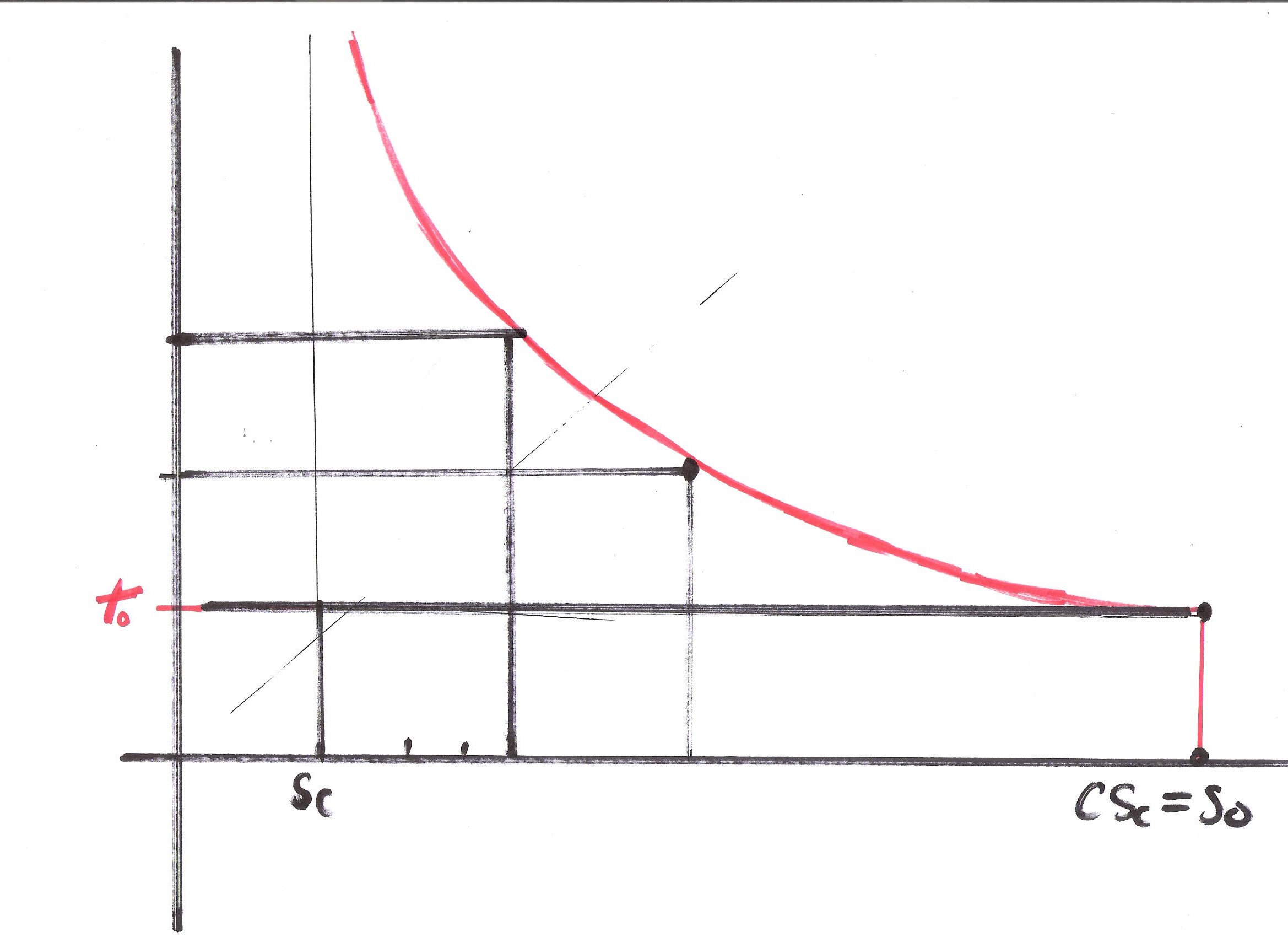
Note that the postulate does not state that the ‘shape’ of the container remains constant, or that the two ‘spatial’ and ‘temporal’ dimensions should individually remain constant. It is the extent of the space-time parallelipod’ s3t which remains the same or, in the case of the rectangle it is the product st ,that is fixed, not s and t individually.  All quantities have minimum and maximum values, so let the minimum temporal interval be named  t0 and, Space time Area diagramconversely, let s0 be the maximum value of s. Thus the quantity s0 t0 ,  the ‘area’ of the space-time rectangle, is fixed once and for all even though the temporal and spatial lengths can, and do, vary enormously. We have, in effect a hyperbola where xy = constant but with the difference that the hyperbola is traced out by a series of dots (is not continuous) and does not extend indefinitely in any direction (Note 3).
         This quantity s0 t0  is an extremely important constant, perhaps the most important of all. I would guess that different values of s0 t0   would lead to very different universes. The quantity is mixed so it is tacitly assumed that there is a common unit. What this common unit is, is not clear : it can only be  based on the dimensions of an ultimate event itself, or its precise emplacement (not its container capsule), since K0 , the backdrop or Event Locality does not have a metric, is elastic, indeterminate in extent.
         Although one can, in imagination, associate or combine all sorts of events with each other, only events that are bonded sequentially constitute an event-chain, and only bonded contemporary events remain contemporary in successive ksanas. This ‘bonding’ is not a mathematical fiction but a very real force, indeed the most basic and most important force in the physical universe without which the latter would collapse at any and every moment — or rather at every ksana.
         Now, within a single ksana one and only one ultimate event can have occurrence. However, the ‘length’ of a ksana varies from one event-chain to another since, although the size of the emplacements where the ultimate events occur is (by hypothesis) fixed, the spacing is not fixed, is indeterminate though the same in similar conditions (Note 5). The length of a ksana has a minimum and this minimal length is attained only when an event-chain is at rest, i.e. when it is considered without reference to any other event-chain. This is the equivalent of a ‘proper interval’ in Relativity. So t is a parameter with minimal value t0. It is not clear what the maximum value is though there must be one.
         The inter-space distance s does not have a minimum, or not one that is, in normal conditions ever attained — this minimum would be the exact ‘width’ of the emplacement of an ultimate event, an extremely small distance. It transpires that the inter-space distance s is at a maximum in a rest-chain taking the value s0. I am not absolutely sure whether this needs to be stated as an assumption or whether it can be derived later from the assumptions already made.)

         Thus, the ‘space-time’ paralleliped s3t has the value (s0)3t0 , an absolute value.

The Rest Postulate

This says that

          Every event-chain is at rest with respect to the Event Locality K0 and may be considered to be ‘stationary’.

          Why this postulate and what does it mean? We all have experience of objects immersed in a fluid medium and there can also be events, such as sounds, located in this medium. Now, from experience, it is possible to distinguish between an object ‘at rest’ in a fluid medium such as the ocean and ‘in motion’ relative to this medium. And similarly there will be a clear difference between a series of siren calls or other sounds emitted from a ship in a calm sea, and the same sequence of sounds when the ship is in motion. Essentially, I envisage ultimate events as, in some sense, immersed in an invisible omnipresent ‘medium’, 0, — indeed I envisage ultimate events as being localized disturbances of K0. (But if you don’t like this analogy, you can simply conceive of ultimate events having occurrence on an ‘Event Locality’ whose purpose is simply to allow ultimate events to have occurrence and to keep them separate from one another.) The Rest Postulate simply means that, on the analogy with objects in a fluid medium, there is no friction or drag associated with chains of ultimate events and the medium in or on which they have occurrence. This is basically what Einstein meant when he said that “the ether does not have a physical existence but it does have a geometric existence”.

What’s the point of this constant if no one knows what it is? Firstly, it by no means follows that this constant s0 t0 is unknowable since we can work backwards from experiments using more usual units such as metres and seconds, giving at least an approximate value. I am convinced that the value of s0 t0  will be determined experimentally within the next twenty years, though probably not in my lifetime unfortunately. But even if it cannot be accurately determined, it can still function as a reference point. Galileo was not able to determine the speed of light even approximately with the apparatus at his disposal (though he tried) but this did not stop him stating that this speed was finite and using the limit in his theories without knowing what it was.

Diverging Regular Event-chains

Imagine a whole series of event-chains with the same reappearance rate which diverge from neighbouring spots — ideally which fork off from a single spot. Now, if all of them are regular with the same reappearance rate, the nth member of Event-chain E0 will be ‘contemporaneous’ with the nth members of all the other chains, i.e. they will have occurrence within the same ksana. Imagine them spaced out so that each nth ultimate event of each chain is as close as possible to the neighbouring chains. Thus, we imagine E0 as a vertical column of dots (not a continuous vertical line) and E1 a slanting line next to it, then E2 and so on. The first event of each of these chains (not counting the original event common to all) will thus be displaced by a single ‘grid-space’ and there will be no room for any events to have occurrence in between. The ‘speed’ or displacement distance of each event-chain relative to the first (vertical one) is thus lateral distance in successive ksanas/vertical distance in successive ksanas.  For a ‘regular’ event-chain the ‘slant’ or speed remains the same and is tan θ   =  1 s/t0 , 2 s/t0  and so on where, if θ is the slant angle,

tan θr  = vr  = 1, 2, 3, 4……   ­­

“What,” asked Zeno of Elea “is the speed of a particular chariot in a chariot race?”  Clearly, this depends on what your reference body is. We usually take the stadium as the reference body but the charioteer himself perceives the spectators as moving towards or away from him and he is much more concerned about his speed relative to that of his nearest competitor than to his speed relative to arena. We have grown used to the idea that ‘speed’ is relative, counter-intuitive though it appears at first.
But ‘distance’ is a man-made convenience as well : it is not an ‘absolute’ feature of reality. People were extremely put out by the idea that lengths and time intervals could be ‘relative’ when the concept was first proposed but scientists have ‘relatively’ got used to the idea. But everything seems to be slipping away — is there anything at all that is absolute, anything at all that is real? Ultimate Event Theory evolved from my attempts to ponder this question.
The answer is, as far as I am concerned, yes. To start with, there are such things as events and there is a Locality where events occur. Most people would go along with that. But it is also one of the postulates of UET that every macroscopic ‘event’ is composed of a specific number of ultimate events which cannot be further decomposed. Also, it is postulated that certain ultimate events are strongly bonded together into event-chains temporally and event-conglomerates laterally. There is a bonding force, causality.
Also, associated with every event chain is its Event Number, the number of ultimate events between the first event A and the last Z. This number is not relative but absolute. Unlike speed, it does not change as the event-chain is perceived in relation to different bodies or frames of reference. Every ultimate event is precisely localised and there are only a certain number of ultimate events that can be interposed between two events both ‘laterally’ (spatially) and ‘vertically’ (temporally). Finally, the size of the ‘space-time capsule’ is fixed once and for all. And there is also a maximum ‘space/time displacement ratio’ for all event-chains.
This is quite a lot of absolutes. But the distance between ultimate events is a variable since, although the dimensions of each ultimate event are fixed, the spacing is not fixed though it will remain the same within a so-called ‘regular’ event-chain.
It is important to realize that the ‘time’ dimension, the temporal interval measured in ksanas, is not connected up to any of the three spatial dimensions whereas each of the three spatial dimensions is connected directly to the other two. It is customary to take the time dimension as vertical and there is a temptation to think of t, time, being ‘in the same direction’ as the z axis in a normal co-ordinate system. But this is not so : the time dimension is not in any spatial direction but is conceived as being orthogonal (at right angles) to the whole lot. To be closer to reality, instead of having a printed diagram on the page, i.e. in two dimensions, we should have a three dimensional optical set-up which flashes on and off at rhythmic intervals and the trajectory of a ‘particle’ (repeating event-chain) would be presented as a repeating pinpoint of light in a different colour.
Supposing we have a repeating regular event-chain consisting for simplicity of just one ultimate event. We [resent it as a column of dots, i.e. conceive of it as vertical though it is not. The dots are numbered 0, 1, 2….    and the vertical spacing does not change (since this is a regular event-chain) and is set at  t0 since this is a ‘rest chain’.  Similar regular event-chains can then be presented as slanting lines to the right (or left) regularly spaced along the x axis. The slant of the line represents the ‘speed’. Unlike the treatment in Calculus and conventional physics, increasing v does not ‘pass through a continuous set of values’, it can only move up by a single ‘lateral’ space each time. The speeds of the different event-chains are thus 0s/t0  (= 0) ;  1s/t0 ;
2s/t0 ; 
 3s/t0 ;  4s/t0 ;……  n s/t0 and so on right up to  c s/t0 .  But to what do we relate the spacing s ?  To the ‘vertical’ event-chain or to slanting one? We must relate s to the event-chain under consideration so that its value depends on v so v =  v sv    The ratio  s/t0 is thus a mixed ratio sv/t0 .   tv  gives the intervals between successive events in the ‘moving’ event-chains and the number of these intervals does not increase because there are only a fixed number of events in any event-chain evaluated in any way. These temporal intervals thus undoubtedly increase because the hypotenuse gets larger. What about the spacing along the horizontal ? Does it also increase? Stay the same?  If we now introduce the Constant Size Postulate which says that the product  sv  tv  = s0 t0    we find that   sv  decreases with increasing v since tv  certainly increases. There is thus an inverse ratio and one consequence of this is that the mixed ratio sv/t0 = s0/tv    and we get symmetry. This leads to relativity whereas any other relation does not and we would have to specify which regular event-chain ‘really’ is the vertical one. One can legitimately ask which is the ‘real’ spatial distance between neighbouring events? The answer is that every distance is real and not just real for a particular observer. Most phenomena are not observed at all but they still occur and the distances between these events are real : we as it were take our pick, or more usually one distance is imposed on us.

Now the real pay off is that each of these regular event-chains with different speeds v is an equally valid description of the same event-chain. Each of these varying descriptions is true even though the time intervals and distances vary. This is possible because the important thing, what really matters, does not change : in any event-chain the number and order of the individual events is fixed once and for all although the distances and times are not. Rosser, in his excellent book Introductory Relativity, when discussing such issues gives the useful analogy of a gamer of tennis being played on a cruise liner in calm weather. The game would proceed much as on land, and if in a covered court, exactly as on land. And yet the ‘speed’ of the ball varies depending on whether you are a traveller on the boat or someone watching with a telescope from another boat or from land. The ‘real’ speed doesn’t actually matter, or, as I prefer to put it, is indeterminate though fixed within a particular inertial frame (event system). Taking this one step further, not just the relative speed but the spacing between the events of a regular  event-chain  ‘doesn’t matter’ because the constituent events are the same and appear in the same order. It is interesting that. on this interpretation, a certain indeterminacy with regard to distance is already making its appearance before Quantum Theory has even been mentioned. 

Which distance or time interval to choose?

Since, apparently, the situation between regular event-chains is symmetric (or between inertial systems if you like) one might legitimately wonder how there ever could be any observed discrepancy since any set of measurements a hypothetical observer can make within his own frame (repeating event system) will be entirely consistent and unambiguous. In Ultimate Event Theory, the situation is, in a sense, worse since I am saying that, whether or not there is or can be an observer present, the time-distance set-up is ‘indeterminate’ — though the number and order of events in the chain is not. Any old ‘speed’ will do provided it is less than the limiting value c. So this would seem to make the issue quite academic and there would be no need to learn about Relativity. The answer is that this would indeed be the case if we as observers and measurers or simply inhabitants of an event-environment could move from one ‘frame’ to another effortlessly and make our observations how and where we choose. But we can’t : we are stuck in our repeating event-environment constituted by the Earth and are at rest within it, at least when making our observations. We are stuck with the distance and time units of the laboratory/Earth event-chain and cannot make observations using the units of the electron event-chain (except in imagination). Our set of observations is fully a part of our system and the units are imposed on us. And this does make a difference, a discernible, observable difference when dealing with certain fast-moving objects.
Take the µ-meson. µ-mesons are produced by cosmic rays in the upper reaches of the atmosphere and are normally extremely short-lived, about  2.2 × 10–6 sec.  This is the (average) ‘proper’ time, i.e.  when the µ-meson is at rest — in my terms it would be N × t0 ksanas. Now, these mesons would, using this t value, hardly go more than 660 metres even if they were falling with the speed of light (Note 4). But a substantial portion actually reach sea level which seems impossible. Now, we have two systems, the meson event-chain which flashes on and off N times whatever N is before terminating, i.e. not reappearing. Its own ‘units’ are t0 and s0 since it is certainly at rest with itself. For the meson, the Earth and the lower atmosphere is rushing up with something approaching the limiting speed towards it. We are inside the Earth system and use Earth units : we cannot make observations within the meson. The time intervals of the meson’s existence are, from our rest perspective, distended : there are exactly the same number of ksanas for us as for the meson but, from our point of view, the meson is in motion and each ‘motion’ ksana is longer, in this case much much  longer. It thus ‘lives’ longer, if by living longer we mean having a longer time span in a vague absolute way,  rather than having more ‘moments of existence’. The meson’s ksana is worth, say, eight of our ksanas. But the first and last ultimate event of the meson’s existence are events in both ‘frames’, in ours as well as its. And if we suppose that each time it flashed into existence there was a (slightly delayed) flash in our event-chain, the flashes would be much more spaced out and so would be the effects. So we would ‘observe’, say, a duration of, say, eight of ‘our’ ksanas between consecutive flashings instead of one. And the spatial distance between flashes would also be evaluated in our system of metres and kilometres : this is imposed on us since we cannot measure what is going on within the meson event-chain. The meson actually would travel a good deal further in our system — not ‘would appear to travel farther’. Calculations show that it is well within the meson’s capacity to reach sea level (see full discussion in Rosser, Introductory Relativity pp. 71-3).
What about if we envisaged things from the perspective of the meson? Supposing, just supposing, we could transfer to the meson event-chain or its immediate environment and could remember what things were like in the world outside, the familiar Earth event-frame. We would notice nothing strange about ‘time’, the intervals between ultimate events, or the brain’s merging of them, would not surprise us at all. We would consider ourselves to be at rest. What about if we looked out of the window at the Earth’s atmosphere speeding by? Not only would we recognize that there was relative motion but, supposing there were clear enough landmarks (skymarks rather), the distances between these marks would appear to be far closer than expected — in effect there would be a double or triple sense of motion since our perception of motion is itself based on estimates of distance. As the books say, the Earth and its atmosphere would be ‘Lorentz contracted’. There would be exactly the same number of ultimate events in the meson’s trajectory, temporarily our trajectory also. The first and last event of the meson’s lifetime would be separated by the same number of temporal intervals and if these first and last events left marks on the outside system, these marks would also be separated by exactly the same number of spatial intervals. Only these spatial intervals — distances — would be smaller. This would very definitely be observed : it is as if we were looking out at the countryside on a familiar journey in a train fantastically speeded up. We would still consider ourselves at rest but what we saw out of the window would be ludicrously foreshortened and for this reason we would conclude that we were travelling a good deal faster than on our habitual journey. I do not think there would be any obvious way to recognize the time dilation of the outside system.

One is often tempted to think that the time dilation and the spatial contraction cancel each other out so all this talk of relativity is purely academic since any discrepancies should cancel out. This would indeed be the case if we were able to make our observations inside the event-chain we are observing, but we make the measurements (or perceptions) in a single frame. Although it is the meson event-chain that is dictating what is happening, both the time and spatial distance observations are made in our system. It is indeed only because of this that there is so much talk about ‘observers’ in Special Relativity. The point is not that some intelligent being observes something because usually he or she doesn’t : the point is that the fact of observation, i.e. the interaction with another system seriously confuses the issue. The ‘rest-motion’ situation is symmetrical but the ‘observing’ situation is not symmetrical, nor can it be in such circumstances.

This raises an important point.  In Ultimate Event Theory, as in Relativity, the situation is ‘kinematically’ symmetrical. But is it causally symmetrical? Although Einstein stressed that c was a limit to the “transfer of causality”  he was more concerned with light and electro-magnetism than causality. UET is concerned above all with causality — I have not mentioned the speed of light yet and don’t need to. In situations of this type, it is essential to clearly identify the primary causal chain. This is obviously the meson : we observe it, or rather we pick up indications of its flashings into and out of existence. The observations we make, or simply perceptions,  are dependent on the meson, they do not by themselves constitute a causal chain. So it looks at first sight as if we have a fundamental asymmetry : the meson event-chain is the controlling one and the Earth/observer event chain  is essentially passive. This is how things first appeared to me. But on reflection I am not so sure. In many (all?) cases of ‘observation’ there is interaction with the system being observed and it is inevitably going to be affected by this even if it has no senses or observing apparatus of its own. One could thus argue that there is causal symmetry after all, at least in some cases. There is thus a kind of ‘uncertainty principle’ due to the  interaction of two systems latent in Relativity before even Quantum Mechanics had been formulated. This issue and the related one of the limiting speed of transmission of causality will be dealt with in the subsequent post.

Sebastian Hayes  26 July
Note 1. And in point of fact, if General Relativity is to be believed, ‘free space’ is not strictly homogeneous even when empty of matter and neither is the speed of light strictly constant since light rays deviate from a straight path in the neighbourhood of massive bodies.

Note 2  For those people like me who wish to believe in the reality of 0 — rather than seeing it as a mere mathematical convenience like a co-ordinate system —  the lack of any ‘friction’ between the medium or backdrop and the events or foreground would, I think. be quite unobjectionable, even ‘obvious’, likewise the entire lack of any ‘normal’ metrical properties such as distance. The ‘backdrop’, that which lies ‘behind’ material reality though in some sense permeating it, is not physical and hence is not obliged to possess familiar properties such as a shape, a metric, a fixed distance between two points and so on. Nevertheless, this backdrop is not completely devoid of properties : it does have the capacity to receive (or produce) ultimate events and to keep them separate which involves a rudimentary type of ‘geometry’ (or topology). Later, as we shall see, it would seem that it is affected by the material points on it, so that this ‘geometry’, or ‘topology’, is changed, and so, in turn,  affects the subsequent patterning of events. And so it goes on in a vicious or creative circler, or rather spiral.
            The relation between K0, the underlying substratum or omnipresent medium, and the network of ultimate events we call the physical universe, K1  is somewhat analogous to the distinction between nirvana and samsara in Hinayana Buddhism. Nirvana  is completely still and is totally non-metrical, indeed non-everything (except non-real), whereas samsara is turbulence and is the world of measure and distancing. It is alma de-peruda, the ‘domain of separation’, as the Zohar puts it.  The physical world is ruled by causality, or karma, whereas nirvana is precisely the extinction of karma, the end of causality and the end of measurement.

Note 3   The ‘Space-time hyperbola’ , as stated, does not extend indefinitely either along the ‘space’ axis s (equivalent of x) or indefinitely upwards Space time hyperbolaalong the ‘time’ axis (equivalent of y).  — at any rate for the purposes of then present discussion. The variable t has a minimum t0   and the variable s a maximum s0  which one suspects is very much greater than  tc  .  Since there is an upper limit to the speed of propagation of a causal influence, c , there will in practice be no values of t greater than tc  and no s values smaller than sc  .   It thus seems appropriate to start marking off the s axis at the smallest value sc  =   s0/ c  which can function as the basic unit of distance.  Then s0 is equal to c of these ‘units’. We thus have a hyperbola something like this — except that the curve should consist of a string of separate dots which, for convenience I have run together.
Note 4  See Rosser, Introductory Relativity pp. 70-73. Incidentally, I cannot recommend too highly this book.

Note 5   I have not completely decided whether it is the ‘containers’ of ultimate events that are elastic, indeterminate, or the ‘space’ between the containers (which have the ultimate events inside them)’. I am inclined to think that there really are temporal gaps not just between ultimate events themselves but even between their containers, whereas this is probably not so in the case of spatial proximity. This may be one of the reasons, perhaps even the principal reason, why ‘time’ is felt to be a very different ‘dimension’. Intuitively, or rather experientially, we ‘feel’ time to be different from space and all the talk about the ‘Space/Time continuum’ — a very misleading phrase — is not enough to dispel this feeling.

To be continued  SH  18 July 2013
 

A ksana is the minimal temporal interval : within the space of a ksana one and only one ultimate event can have occurrence. There can thus be no change whatsoever within the space of a ksana — everything is at rest.
In Ultimate Event Theory every ultimate event is conceived to fill a single spot on the Locality (K0) and every such spot has the same extent, a ‘spatial’ extent which includes (at least) three dimensions and a single temporal dimension. A ksana is  the temporal interval between the ‘end’ of one ultimate event and the ‘end’ of the next one. Since there can be nothing smaller than an ultimate event, it does not make too much sense to speak of ‘ends’, or ‘beginnings’ or ‘middles’ of ultimate events, or their emplacements, but, practically speaking, it is impossible to avoid using such words. Certainly the extent of the spot occupied by an ultimate event is not zero.
The ksana is, however, considerably more extensive than the ‘vertical’ dimension of the spot occupied by an ultimate event. Physical reality is, in Ultimate Event theory, a ‘gapped’ reality and, just as an atom is apparently mainly empty space, a ksana is mainly empty time (if the term is allowed)..  Thus, when evaluating temporal intervals the ‘temporal extent’ of the ultimate events that have occurrence within this interval can, to a first approximation, be neglected. As to the actual value of a ksana in terms of seconds or nanoseconds, this remains to be determined by experiment but certainly the extent of a ksana must be at least as small as the Planck scale, 6.626 × 10⁻³⁴ seconds.
A ‘full’ event-chain is a succession of bonded ultimate events within where it would not be possible to fit in any more ultimate events. So if we label the successive ultimate events of a ‘full’ event-chain, 0, 1, 2, 3……N  there will be as many ksanas in this temporal interval as there are ultimate events.
Suppose we have a full event-chain which, in its simplest form, may be just a single ultimate event repeated identically at or during each successive ksana. Such an event-chain can be imaged as a column of dots where each dot represents an ultimate event and the space in between the dots represents the gap between successive ultimate events of the chain. Thus , using the standard spacing of 2.5  this computer we have

Now, although the ‘space’ occupied by all ultimate events is fixed and  an absolute quantity (true for ‘all inertial and non-inertial frames’ if you like), the spacing between the spots where ultimate events can occur both ‘laterally’ — laterally is to be understood as including all three normal spatial dimensions — and vertically, i.e. in the temporal direction, is not  constant but variable. So, although the spots where ultimate events can occur have fixed (minuscule) dimensions, the ‘grid-distance’, the distance between the closest spots which have occurrence within the same ksana,  and so  does the temporal distance between successive ultimate events of a full event-chain. So the ksana varies in extent.  However, there is, by hypothesis,  a minimum value for both the grid-distance and the ksana. The minimal value of both is attained whenever we have a completely isolated event-chain. In practice, there is no such event-chain any more than, in traditional physics, there is a body that is completely isolated  from all other bodies in the universe. However, these minimal values can be considered to be attained for event-chains that are sufficiently ‘far away’ from all other chains. And, more significantly, these minimal values apply whenever we have a full regular event-chain considered in isolation from its event environment.
The most important point, that cannot be too strongly emphasized, is that although the number of ultimate events in an event-chain, or any continuous section of an event-chain, is absolute, the interval between successive events varies from one chain to another, though remaining constant within a single event-chain (providing it is regular). Unless stated otherwise, by ‘ksana’ I mean the interval between successive ultimate events in a ‘static’ or isolated regular event-chain. This need not cause any more trouble than the concept of intervals of time in Special Relativity where ‘time’ is understood to mean ‘proper time’, the ‘time’ of a system at rest, unless a contrary indication is given.
Thus, the ‘vertical’  spacing of events in different chains can and does differ and the minimal value will be represented by the smallest spacing available on the computer I am using. I could, for example, increase the spacing from the standard spacing to

•           or to                     •

•                                     •

moment’, is not an absolute. However, unless stated otherwise, by ‘ksana’ we are to understand the duration of a ksana within a ‘static’ or isolated regular event-chain. This should not cause any more trouble than the concept of ‘time’ in Special Relativity where ‘time’ is understood to mean ‘proper time’, the ‘time’ of a system at rest, unless a contrary indication is given. However, the ‘vertical’  spacing of events in different chains can and does differ. I could, for example, increase the spacing from the standard spacing to

•           or to                     •

•                                        •

•                                       •

S.H. 11/7/13

General Laws :  I suspect that there are no absolutely general ‘laws of Nature’, no timeless laws such as those given by a mathematical formula : such a formula at best only indicates norms or physical constraints. Of all so-called laws, however, the most general and the most solidly established are arithmetic (not physical) laws, rules based on the properties of the natural numbers. To this extent Pythagoras was in the right.

Platonic Forms  Plato was also essentially right in proclaiming the need for ‘ideal’ forms : patterns which are not themselves physical but which dictate the shape and behaviour of physical things. But he was wrong to see these patterns as geometrical, and thus both static and timeless (the two terms are equivalent). With one or two exceptions contemporary science has done away with Platonic Forms though it still puts mathematics in the supreme position.
In practice, I do not see how one can avoid bringing in a secondary ‘ideal’ domain which has a powerful effect on actual behaviour. In Ultimate Event Theory, associations of events and event-chains, once they have attained a critical point, bring into existence ‘event schemas’ which from then on dictate the behaviour of similar collections of events. From this point onwards they are ‘laws’ to all intents and purposes but there was a time when they did not exist and there will perhaps be a future time when they will cease to be operative.
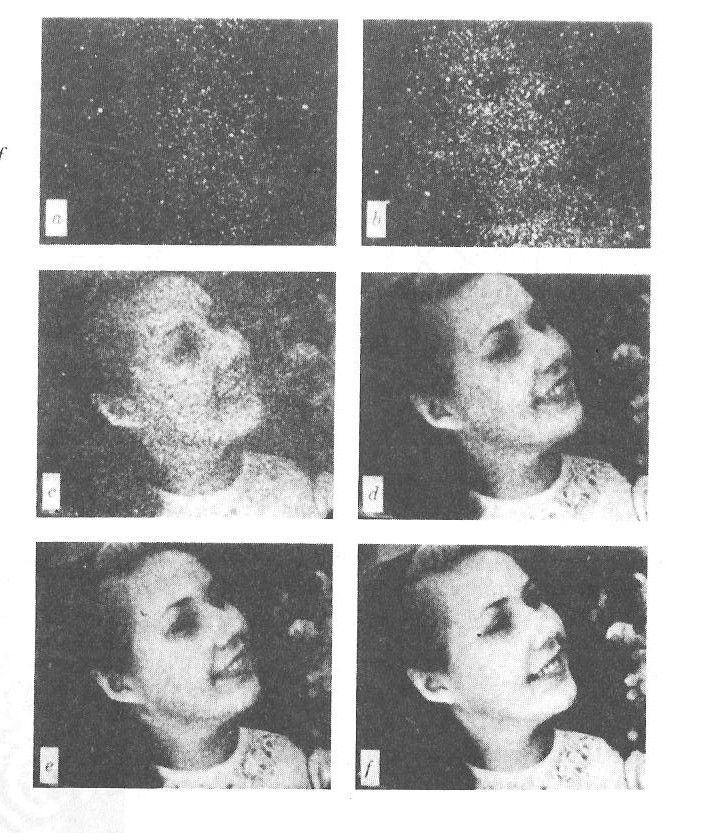
Random GenerationTake the well-known example of interference patterns produced by photons or electrons on a blank screen. It is possible to fire off these ‘particles’ one at a time so that the pattern takes shape point by point, or pixel by pixel if you like. At first the dots are distributed randomly and in different experiments the pattern builds up differently. But the final pattern, i.e., distribution of dots, is identical ─ or as nearly identical as experiment allows. This makes no kind of sense in terms of traditional physics with its assumption of strict causality. The occurrence of a particular event, a dot in a particular place, has no effect whatsoever (as far as we can tell) on the position of the next dot. So the order of events is not fixed even though the final pattern is completely determinate. So what dictates which event comes next? ‘Chance’ it would seem. But nonetheless the eventual configuration is absolutely fixed. This only makes sense if the final configuration follows an ‘event schema’ which does, in some sense, ‘exist’ though it has no place in the physical universe. This is a thoroughly Platonic conception. O

 Ultimate Reality   Relatively persistent patterns on an  underlying invisible ‘substance’ ─ that is all there is in the last resort. Hinduism was quite right to see all this as an essentially purposeless, i.e. gratuitous, display ─ the dance of Shiva. Far from being disheartening, this perspective is inspiring. It is at the opposite extreme both to the goal-directed ethos of traditional Christianity ─ the goal being to ‘save’ your soul ─ and to the drearily functional universe of contemporary biology where everything is perpetually seeking a fleeting  physical advantage over competitors.
What, then, is the difference between the organic and the inorganic?  Both are persistent, the inorganic more so than the organic. Without a basic ‘something’, nothing visible or tactile could or does exist. Without persistence there would be no recognizable patterns, merely noise, random flashes of light emerging from the darkness and subsiding into darkness after existing for a moment only. ‘Matter’ is an illusion, a mental construct : patterns of light (radiation) emerging and disappearing, that is all there is.

Dominance  The ‘universe’ must be maintained by some sort of force, otherwise it would collapse into nothingness at any moment. For Descartes this force came from God, Schopenhauer views it as something inherent in Nature, as what he calls ‘Will’ and which he views as being entirely negative, indeed monstrous. This ‘force’ is what I term dominance, the constraining effect one event or event-chain has on another (including on itself), and without it everything would slow down and very soon disappear without leaving a trace. Take away Schopenhauer’s Will, the force of karma, and this is what would happen ─ and in the Buddhist world schema will eventually happen. For Buddhism, the natural state of everything is rest, inaction, and the universe came about because of some unexplained disturbance of the initial state of rest, indeed is this disturbance. Subsequently, it is as if the ‘universe’ were frantically trying to get back to its original state of complete rest but  by its ceaseless striving is precisely making this goal more and more unattainable.

Disappearance  In both traditional and contemporary physics, it is impossible for an object to simply disappear without leaving a trace. The dogma of the conservation of mass/energy says that nothing ever really disappears, merely changes its form. However, according to Ultimate Event Theory, ultimate events are appearing and disappearing all the time and they need no ‘energy’ to do this. Certain of these ultimate events produced at random eventually coalesce into repeating event-chains we perceive as solids or liquids because they acquire ‘persistence’ or self-dominance, but it is conceivable that they can, in certain exceptional circumstances, lose this property and in such a case they will simply stop reappearing.
Are there any genuine cases where objects have completely disappeared in this way? The only evidence for them would seem to be anecdotal : one hears of certain Hindu magic-men who are able to make small objects disappear and appear in a different place but it is, of course, difficult to judge to distinguish genuine magic from the stage variety. And any such alleged cases rarely if ever get investigated by scientists since the latter are terrified of being accused of credulity or worse. Professor Taylor who investigated Uri Geller was told by colleagues that no reputable scientists would do such a thing. Clearly, if one is not allowed to investigate a phenomenon it has no chance of ever being verified which is what the rationalist/scientific lobby desire.
Contemporary science and rationalist thinking implicitly assumes that ‘real’ entities, while they actually exist, exist continuously ─ in fact the previous statement would be regarded as so obvious as to be hardly worth stating. But in UET nothing exists for more than an instant (ksana) and entities that seem to exist for a ‘long time’ are in reality composed of repeating ultimate events strongly bonded together. If reality is ‘gapped’, as UET affirms, all so-called objects alternately appear and disappear (though so rapidly that we do not notice the change) so  there is much less of a problem involved in making something disappear. Instead of actually destroying the object in some way (and in the destructive process transferring the object’s mass into different mass or pure energy) it would simply be sufficient to prevent an event cluster reappearing which is not quite so hard to imagine. In UET, an apparent object reappears regularly because  it possesses ‘self-dominance’; if it could be made to lose this property, it would not reappear, i.e. would disappear, and it would not necessarily leave any trace. Moreover, to make something disappear in this manner. it would not be necessary to use any kind of physical force, high temperature, pressure and so on. To say that the theoretical possibility is there is not, of course, the same thing as saying that a supposed occurrence actually takes place : that is a matter of experiment and observation. In my unfinished SF novel The Web of Aoullnnia devotees of a  mystical sect called the Yther are not only convinced that the entire universe is going to disappear into the nothingness from which it emerged, but  believe that they should hasten this progressive movement which they call Aoullnnia-yther where yther means ‘ebbing’, ‘withdrawal’, hence the name of the sect. Although contemporary Buddhists do not usually put it quite so starkly, essentially the aim of Buddhism is to return the entire universe to an entirely quiescent state “from which it never will arise again”.

On the other hand, deliberately bringing something into existence from nothing is just as inconceivable in Ultimate Event Theory as in contemporary physics, maybe more so.                  SH  22/5/13


It is said that certain Gnostic sects which flourished in North Africa during the first few centuries of our era not only encouraged but actually required candidates to give a written or verbal account of how they thought the universe began (Note 1). It would be interesting to know what these people came up with and, most likely, amongst a great deal of chaff there were occasional anticipations of current scientific theories. It is mistaken to imagine that great ideas go hand in hand with experimentation and mathematical implementation : on the contrary, important ideas often predate true discovery by centuries or even millennia. Democritus’ atomic theory (VIth century BC) could not possibly have been ‘proved’ prior to modern times and he certainly could not possibly have put it in quantum or even Newtonian mathematical form. Similarly, one or two brave people put forward the germ theory of disease while the ‘miasmic’ theory was still orthodoxy ─ and were usually dismissed as cranks.
As a body of beliefs, ‘science’ is currently entering a period of consolidation comparable to that experienced by the early Church after its final victory over paganism. Materialism has decisively vanquished idealism and religion is no longer a force to be reckoned with, at least in the West. Along with increasing potency and accuracy goes a certain narrowing of focus and a growing intolerance : science is now a university phenomenon with all that this implies and no .longer a ‘pastime of leisured persons’. To some extent, this tendency towards orthodoxy is inevitable, even beneficial : as someone said it doesn’t matter too much if a poet departs from  the prescribed form of a sonnet, but it may matter a great deal if a bridge builder uses the wrong equations. Nonetheless, there are warning signs : ‘scientific correctness’ has replaced not only free enquiry but the very idea of scientific validity. Professional scientists worry, not so much about whether their results are flawed or their theories tentative, as to whether they are going to get in trouble with the establishment, and offending the latter can have grave career and financial consequences.

        It is true that free, indeed often extremely erratic  speculation, is still allowed  in certain areas, especially cosmology and particle physics. But it is subject to certain serious constraints. Firstly, it is only permitted to persons who already hold more than one degree and who are able to couch their theories in such abstruse mathematics that journals find it difficult to find anyone to peer review the work. Is not this how it should be? Maybe not. Certainly, you are likely to need some knowledge of a subject before cobbling together a theory but there is such a thing as knowing too much. Once someone has been through the mill and spent years doing things in the prescribed manner, it is well nigh impossible to break out of the mental mould ─ and this is most likely the reason why really new ideas in science come from people in their twenties (Einstein, Heisenberg, Dirac, Gamow et al. et al.), not because of any miraculous effect of youth as such.

        So. Where’s all this leading?  I didn’t do science at university or even at school which puts me in many respects at an enormous disadvantage, but this has certain good aspects as well. I have no vested interest in orthodoxy and only accept something because I am convinced that it really is true, or is at least the best theory going for the time being. Almost all current would be innovators in science, however maverick they may appear at first sight, take on  board certain key doctrines of modern science such as the conservation of energy or the laws of thermo-dynamics. But one might as well  be killed for a sheep as a lamb and I have finally decided to take the plunge and, instead of trying to fit my ideas into an existing official framework, to swim out into the open sea, starting as far back as possible and  assuming only what seems to be essential. I originally envisaged ‘Ultimate Event Theory’ as a sort of ‘new science’  but now realize that what I really have been trying to do is give birth to a new ‘paradigm’ ─ a ‘paradigm’ being a systematic way of viewing the world or reality. Should this paradigm ever come to fruition, it will engender new sciences and new technologies, but the first step is to start thinking within a different framework and draw conclusions. In other words, one is obliged to start with theory ─ not experiment or mathematics though certainly I hope eventually experiments will give support to the key concepts and that a new symbolic system will be forthcoming (Note 2).

       Four Paradigms

 To date there have been basically four ways of viewing the world, three all-englobing ‘paradigms’ : (1) The Animistic paradigm; (2) the Mechanistic paradigm; and (3) the Information Paradigm and (4) the Event Paradigm.
According to (1) the universe is full of life, replete with ‘beings’ in many respects like ourselves inasmuch as ‘they’ have emotions and wills and cause things deliberately to happen. This conception goes far beyond mere belief in a pantheon of gods and goddesses : as Thales is supposed to have said, if a lodestone draws a piece of iron it is exercising ‘will’ and “All things are full of gods”. This world-view lasted a very long time and, even though it is largely discredited today, it still has plenty of life  left in it which is why we still speak of ‘charm’, ’charisma’, ‘fate’, and so on and why, despite two centuries of rationalistic propaganda, most of the population still believes in ‘jinxes’ and in ‘spirits’ (as I myself do at least part of the time).
The countless deities and “thrones, principalities and powers” against whom Saint Paul warns the budding Christian eventually gave way to a single all-powerful Creator God who made the world by a deliberate act of will. In its crudest form, Mechanism views the universe as a vast and complicated piece of clockwork  entirely controlled by physical and mathematical laws, some of which we already know. No living things of any sort here unless we make an exception for humanity and, even if we do make such an exception, it is hard to see how free will can enter the picture. Modern science has dispensed with the  Creator retained the mechanistic vision somewhat updated by quantum uncertainty and other exotic side effects.
The invention of the computer and its resounding success sometimes seems to be ushering in a new paradigm: the universe is an enormous integrated circuit endowed with intelligence of a sort and we are the humble bits. Seductive though this vision is in certain respects, it is not without serious dangers for the faithful since it looks disturbingly like a sort of reversion to the most ancient paradigm of all, the animistic one ─ the universe is alive and capable of creating itself and everything else out of itself.
The paradigm that I am working with harks back to certain Indian Buddhist thinkers of the early centuries AD though I originally discovered it for myself when I knew nothing about Buddhism and Taoism. No Creator God, no matter or mind as such, only evanescent point-like entities (‘dharmas’, ‘ultimate events’) forming relatively persistent patterns on a featureless backdrop which will eventually be returned to the original emptiness (‘sunyata’) from which the “thousand things” emerged.

Broad schema of Eventrics 

Following my own instincts and the larger cosmology of Taoism and other mystical belief systems, I divide reality into two broad categories, what I call the Manifest and the Unmanifest, each of which is further divided into two, the Non-Occurrent and the Occurent. If one feels more comfortable with a symbolic notation, we can speak of K0  and K1 with further regions K00 and K01, K10 and K11.  Of the Unmanifest Non-Occurrent, K00, little need or can be said. It is the ultimate origin of everything, the original Tao, Ain Soph (‘the Boundless’) of Jewish mysticism, the Emptiness of nirvana, the vacuum of certain contemporary physical theories (perhaps).

To be continued)

Note 1  As soon as Christianity, or a particular version of it, became the official religion of the declining Roman Empire, all such cosmological speculation was actively discouraged and penalized.

Pagoda

The speaker alias myself commenced by saying he aimed to give a rapid overview of the subject 1 as a mathematical and physical concept 2 its connection to religion and mysticism and 3 possible social and technological consequences of the elimination of the concept from science and mathematics.      

Definition I defined ‘infinity’ as “a process that can be started but never concluded”. Usually the process involves making something ‘bigger and bigger’ or ‘smaller and smaller’ as in Calculus. “Infinity is a process or procedure, not a quantity”. I should have added that I was well aware that are more precise, also more sophistical, mathematical definitions but at the end of the day we come down to this  that  infinity is a procedure or activity that never terminates and never can.

Is the concept attractive ? “Not to me,” the speaker  said. “My dislike of infinity dates back to my childhood when a familiar sight on the breakfast table was a brand of honey which had a bear on the label. The bear was holding a jar of honey with a bear on it holding a jar of honey and so on….This used to torture me at night until I fell asleep with exhaustion.

Necessary as a concept?  The Greeks got on very well indeed without it though, arguably, their finitism stopped them developing the science of dynamics. It would have been possible in my view to have developed the calculus without dragging in the infinite but the Greeks just stopped short of doing this though Archimedes came near.  Fast forward to the Renaissance. This  was a period when the West was liberated from the medieval obsession with ‘infinite time’ (eternity), and the new optic gave rise to the exploration of the physical world  by navigation and the loving depiction of the human body in painting and sculpture. “However, the concept of infinity made its fateful appearance with Galileo and others leading eventually to the ‘Infinitesimal Calculus’ (as it was called until very recently) though Newton seems to have had some doubts about the validity of his great invention.”  The grip of infinity finally began to loosen at the end of the pragmatic nineteenth century but then mathematics plunged ever deeper into the mire of infinity with Cantor’s theory of the Transfinite, infinity gone mad (and Cantor himself did) . Adapting a simile from Nietzsche, I said that the concept of infinity was like the gigantic statue of a dead god whose baleful shadow lay across the valley below terrifying the inhabitants and stopping them going about their daily business.

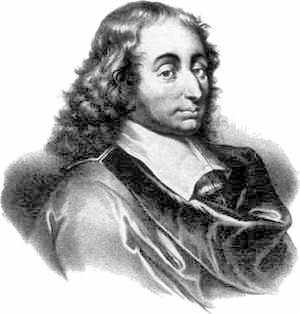
The Revealing Case of Pascal “Le silence absolu des espaces infinis m’effraient” (The absolute silence of infinite space terrifies me). Pascal wrote this.
Pascal“It is interesting that Pascal, the man who discovered the Law of Uniform Pressure for Gases, built the first working calculator and contributed to the Calculus, had a mystical experience one night around this time of year and from then on abandoned the ‘sterile infinity of mathematics’ for the warmth of a personal relationship with God.”
“But,” I added, “if Pascal had been alive today he would perhaps not have needed to abandon the world and science. For we now know that the universe is not finite ─ we can even judge its extent ─   and it is not silent since we hear it if not with our ears at least with radio telescopes. The universe is no longer  forbidding and distant; we know, or think we know, the constituents of the stars and galaxies, however huge, are like grains of sand scattered across the ground. We are part of the universe since, as this gentleman will tell you, [a chemist in the audience] the carbon and other elements in our bodies comes from exploded stars.”

Everything physical is finite  At one time almost everything was thought to be ‘infinite,’ ‘eternal’. But we now know, for example, that the speed of light is  not infinite, that the universe itself had a beginning in time and has a specific size. Energy is not continuous but can only be  distributed in definite quantities (the famous quanta of Quantum Mechanics); molecules and atoms can even be ‘seen’ by electron microscopes.
The Differential Calculus is basically the study of how two sets of quantities change with respect to each other, one variable ‘depending’ on the other. In mathematics the independent variable can be made arbitrarily small. But if you reduce the input of a  mechanical system beyond a certain point, this input is unable to overcome internal friction and there is no output whatsoever. And this limit is miles away far from the mathematical one. “Touch the person next to you as lightly as possible. Then lighter still. You will soon get to the point when this person does not recognize the pressure of your hand. Everything is like this, there is always a smallest and largest possible amount in real life. Calculus models an ideal world, not the real one.”
Today there is some talk of there being a finite ‘smallest length’, the Planck scale (10 (exp) –34), but very rarely talk of there being a smallest interval of time, what I call the ksana (from Sanscrit for ‘instant’). Time is actually the most important dimension since, as Pearce wrote, “one can imagine a world without space but not a world without time”. Although the ‘space’ of our dreams is completely distorted, this does not happen with time : one event leads to another just as in real life. In dreams as in real life you never get stuck in a vicious circle going round and round for ever: there is a ceaseless drive onwards and in a single direction. Time is cvery different from space since it only has one ‘dimension’ and it is dislocated from the three spatial dimensions, “the spatial three-dimensional reality must disappear when time is introduced since otherwise there would be no difference from what exists at one moment and the next”.

The Infinite compared with the ‘Non-finite’

Is the universe self-sufficient and self-explanatory? It would seem not since even science is now seriously talking about it coming from something that was there before, and which will perhaps give rise to other, different, universes. This deeper reality, the ‘Origin’, Ain Soph, call it what you will, has (so I would claim) nothing in common with the mathematical concept of infinity – the Buddha is credited with the just observation that “nirvana is neither finite nor infinite”.
The speaker said he envisaged ‘reality’ as made up of two regions with a veil separating them (the veil of Isis). Mystics have lifted a corner of this veil and have sometimes described what they have seen on the other side. The Beyond is so completely different from everything in the physical universe that mystics, quite rightly describe it in contradictory or negative terms. On the other side there is no number, no shape, no name, no elementary particles, no difference between the part and the whole “All is One”.
However, we live on this side of the veil, in the world of separation, the world of extension and number and mathematics and physics should confine themselves to what is measurable and/or deducible from our (ordinary) sense impressions.  Above all we should not bring into science and mathematics any knowledge (or delusory imaginings) concerning the ‘non-finite’ domain of reality.
“The Tao that can be named is not the origin al Tao” – the first line of the Tao Te Ching. In Lao Tse’s time, language was the most accurate analytic tool known to mankind : if Lao Tse were alive today he would have written “The Tao that can be numbered or mathematized is not the original Tao”.
I have found this stratagem of separating reality into two, and only two, incompatible regions, one finite, specific, measurable, the other non-finite and immeasurable very useful indeed (Note 1).
Strangely enough, the bridge, inasmuch as there is one, between the two realms is not to be found by reaching out into the vastness with  bigger telescopes and torturing oneself with the concept of the infinite, but on the contraryby focussing on the present moment, any moment, this moment. I pointed to the sunlight falling on the grass alongside where we were standing.

Is it possible to show that there is a ‘smallest interval of time’? Is the hypothesis testable?

I made the prediction in one of the early posts on this site, that “during this century science will be able to determine the ratio of the smallest interval of distance to that of the smallest interval of time”. I added that I thought this would not happen in my lifetime. But to my astonishment, someone (Craig Hogan) is currently building a machine he calls an Interferometer in Chicago precisely to show that, as he conceives things, “Space/Time is grainy” or in the current jargon “At a certain level the universe is digital.” Hogan is looking for a basic ‘static’ that goes deeper even than fluctuations of the quantum vacuum and which he sees as the “froth of Space/Time” (Note 2).

There are, incidentally, several thinkers today who view the universe as a giant computer and this came up in the discussion later. “What I note is that a digital computer is made up of a finite collection of bits, carries out finite series of operations sequentially  and has two and only two ‘states’, ‘on’ and ‘off’.” In life terms, ‘on’ is ‘existent’ and ‘off’ is ‘inexistent’ and reality is flickering on and off perpetually. “We are bits”, and the person who raised issue, somewhat to my surprise, did not take this as an insult but nodded in agreement.

I also noted that the universe is expanding faster and it does not look like it will ever contract again now. Everything has its time, “You will die, I will die and the universe will die”, the speaker said somewhat melodramatically.

Social and technological aspects of ‘infinity’

The speaker, i.e. myself, did not have time to say too much about social and technological matters because of the cold.  He would have liked to say more about how science and mathematics, now everywhere triumphant, have made the world and life almost totally incomprehensible (hence the heasdlong flight towards religious fundamentalism). Theoretical scientists and mathematicians seem to be engaged in a sort of competition, on the one hand they say “See all the improbable or impossible things I can believe in and you can’t!”  and on the other “See all the stipid things you believe in and I don’t”. (Things like free will and that you have the ability to change your life overnight if you really want to.)   We are moving at an alarming rate towards scientific totalitarianism: science has ceased to be a free enquiry but a matter of signing up to a credo and watch your step if you disagree with Richard Dawkins & co. on any point for you’ll live to regret it — if you’re a professional scientist that is, I can think what I want.
I believe all knowledge is based on sense impressions and this is the point where we should start. No exception should be made for mathematics and speculative science. What is dismissed by science as ‘anecdotal’ is actually in a way more genuine and more real than what is carried out in the artificial environment of laboratories. A practising chemist at a family gathering discussingthese sort of issues, said like a bolt from the blue to everyone;’s astonishment, “Only the experiment is real, all the rest is theory”. I’m not sure that I wouldn’t go one step further and say “Only the experience is real”.
On the social level, he/I referred to a book popular for as a while in the Sixties but now forgotten, Cain’s Book by Alexander Trocchi. In this book, the central character lives on a boat moored near New York. He is paid to be there by the owner and does not have to do anything much except potter around so he has plenty of time on his hands. He sees in the distance the vast city that he calls “the city of outrageous purpose” (an excellent phrase) but rarely ventures into it. He spends his time desultorily (but on the whole enjoyably) looking at the water and occasionally meeting one or two drop outs. He contrasts “the city of outrageous purpose” (spatial) with “the meaningless texture of the present moment” (temporal). He prefers the second to the first obviously – though unfortunately Trocchi’s interest in the ‘texture of the present moment’ took him into hard drugs, an unnecessary and counter-productive move.

Spatial and Temporal Cultures

      We live in a spatial civilisation which prizes ‘things’ above sensations. We have an ‘object-orientated outlook’which ultimately goes back to the Greeks whose greatest achievements were strictly spatial (geometry and sculpture). Democritus supposedly said “Nothing exists except atoms and void” and his atoms, like Newton’s, were indestructible and eternal. This view of the world, duly extended  by Galileo and Newton, has taken us to where we are now and I certainly don’t want to disparage the fantastic achievements dependent upon it.
But at around the same time as Democritus was active (VIth cetury BC) a homeless wanderer came to exactly the opposite conclusion, namely that “Everything is ephemeral, a ceaseless succession of point-like instants in a state of commotion”. This is the great thought of a timelike civilization and, strangely, though it has given rise to great art and poetry, it never gave rise to a form of science and technology like the spatial take on reality (Note 3). The speaker  stated cryptically that the concept of ‘the moment’ will soon give rise to a different kind of science and even a new technology. (My ponderings on this theme will be the subject of a subsequent post.)

Conclusion

I concluded by saying that it was completely appropriate that this discussion was taking place in (or rather just outside) an edifice built in honour of the Buddha. The briefest summary of (Hinayana) Buddhism is the following credo
“The Great Recluse identified the elements of existence (dharma), their causal interconnection (karma) and their ultimate extinction (nirvana)”.

Finally – and this was completely unplanned and a surprise even to me – I said “My message to you is ‘Hold fast to the moment’, ‘Seize the moment’ ”.

Intelligent discussion followed from the audience but we had to call it a day because of the weather.

Postscript Subsequently, I formed the project of giving a series of talks on related subjects in the open air at the Pagoda, probably on the last Sunday of each month (watch this space). If no one turns up it doesn’t really matter as it is a good place to be.      SH   15/12/12

_______________________________

Note 1   This principle of the ‘Seaparation of the Spheres” enables me to dismiss at one fell swoop the Theory of the Transfinite and all the Set Theory that depends on it as nonsense which indeed is how it appears to the ordinary person (if such still exist). I must admit to having some trouble deciding how to fit the ‘reality’, if it be reality, of what is described by the wave function in Quantum Mechanics into my schema — does the Schrodinger equation describe anything that really exists or not? But I’m in good company here since debate on the subject still rages unabated. .

Note 2.  See article Scientific American, February 2012   “Craig Hogan believes that the world is fuzzy…… [he] thinks that if we were to peer down at the tiniest subdivisions of space and time, we would find a universe filled with an intrinsic jitter, the busy hum of static. This hum does not come from particles bouncing in and out of being or other kinds of quantum froth that the physicists have argued about in the past. Rather Hogan’s noise would come about if space was not, as we have long assumed, smooth and continuous, a glassy backdrop to the dance of fields and particles. Hogan’s noise arises if space is made of chunks. Blocks. Bits. Hogan’s noise would imply that the universe is digital.
He has devised an experiment to explore the buzzing at the universe’s most fundamental scales.”   Scientific American, February 2012

As I see it, if Hogan picks up an irreducible ‘static’ that is regular, this may well be caused by the spatial shift from one ksana to another. If, however, as I would expect, the noise is random, it would not come from ‘Space/Time’ (what I call the Locality) but from stray ‘ultimate events’ springing into existence and then disappearing without being able to form stable event-chains. There are, I suspect, very many more (I nearly said an ‘infinite number’ of) ultimate events that ‘do not make it’ and merely disappear for ever —  just as there are many many more elementary particles than the ones that form themselves into stable atoms.

Note 3  The men who elaborated the ‘dharma theory’ certainly had the clarity and intelligence to initiate a scientific revolution but their principal or exclusive concern was ‘soteriological’ : to provide a cure for mankind’s unhappiness. There was no point in delving deeper into the mechanisms underlying the physical (pseudo)world, the world of maya, and so, although the developed a system of logic and psychology (to help people towards enlioghtenment), they never developed a systematic physics.       SH  


Pagoda I want to start by expressing my gratitude to MeetUp in general and the London Futurists in particular for enabling this event to take place at all, the first time ever that my ideas have been aired in a public place. I intended to conclude the meeting with an expression of my debt to MeetUp,  the Futurists and founder/organiser David Wood, but unfortunately this slipped my mind as the meeting broke up fairly rapidly after a full hour in the cold. (A summary of my talk will be given in a subsequent post.)
The meeting at the Pagoda on Sunday was, as far as I am concerned, well attended — I did not expect or desire  crowds. All those present seem to have had serious intent and to judge by the thoughtful comments made in the discussion afterwards (drastically curtailed because of the cold) they grasped the main drift of my argument. Some missed the meeting because of the weather or did not find us because we were hidden behind a wall on the south side of the Pagoda.

Two persons have already said they would like to have heard the talk and wondered whether there could be a repeat. However, I feel that my ideas are rather far from the framework and general ethos of the London Futurists — though naturally if asked I would be glad to repeat the talk indoors somewhere at a later date. Instead, I plan to have a monthly series of talks/discussions on various issues arising from ‘Ultimate Event Theory’, the scientific and philosophical system I am currently developing. The place will remain the Peace Pagoda, Battersea Park, South facing wall, at 2 p.m. on a date to be announced, probably the last Sunday of each month — watch this site in January. If no one comes at all, the session won’t be wasted since I will be periodically renewing my contact with the ideas of the Buddha via the beautiful edifice in Battersea Park.

What follows is ‘matters arising’ from the talk:

Three stages

It is said that every new scientific idea goes through three stages : Firstly, they say it is not true, secondly, they say it is not important and, thirdly, they credit the wrong person.
Although I am to my knowledge the first person to have taken the world-view of Hinayana Buddhism seriously as a physical theory (as opposed to a religious or metaphysical doctrine), it is entirely appropriate that the first time Ultimate Event Theory was presented verbally to the public the venue was the Peace Pagoda (built by practising Buddhist craftsmen) since the theory I am developing, “Ultimate Event Theory”, can be traced back to the founder of one of the five great world religions, Buddhism.
Our science stems from the Greeks, in particular the atomist Democritus of Abdera  whose works have unfortunately been lost. He is credited with the amazing statement — reductionist if ever there was one —  “Nothing exists except atoms and void“. These atoms Democritus (and Newton) believed to be indestructile and eternal. Although we now know that some atoms decay, the statement is not so far out : around us are protons and neutrinos that have existed since the Big Bang nearly 15 billion years ago (or very soon afterwards). And as for the void, it is healthier and more vibrant than ever, since it is seething with quantum activity (Note 1).
Dharma    But around the same time when Democritus decided that the ultimate elements of existence were eternal atoms, Gautama Buddha in India reached exactly the opposite conclusion, namely that the dharma (‘elements’) were evanescent and that everything (except nirvana) ‘lasted for a moment only’.  A Buddhist credo summarised the teaching of the Buddha thus: “The Great Recluse identified the elements of existence (dharma), their causal interconnection (karma) and their ultimate extinction (nirvana)” (Stcherbatsky, The Central Conception of Buddhism).
I must emphasize that the theory I am developing, Ultimate Event Theory, is a physical theory (though it has ramifications far beyond physics) and does not presuppose any religious belief, still less is it an underhand way of ‘preaching Buddhism’ or any other form of religion. The Buddha himself founded no Church and spent the latter part of his long life wandering around India giving talks in the open air to anyone who cared to listen. My original interest in Buddhist theory was ‘scientific/philosophical’ rather than ‘spiritual’.  It seemed to me that Gautama Buddha had, through the practice of meditation, intuited certain basic features of physical and mental reality, and concluded correctly that matter, mind, soul, personality and so on are all ‘secondary’ not primary entities — in today’s parlance they are ’emergent’ entities. He also saw, or rather felt, that ‘existence’ was not continuous but that everything (incuding the physical universe) is, as it were, being destroyed and recreated at every instant (the Theory of Instantaneous Being). I do not personally, however, conclude that the personality, consciousness, free will and so on are ‘illusory’ as the Buddhist tradition seems to have inferred, merely not primary, not basic.  At bottom we are seemingly all made up of elementary particles and forces between these particles but at a deeper level still I believe that everything is composed of momentary ‘ultimate events’ flashing into existence and then disappearing for ever. As far as I am concerned the buck stops here : beyond the dharma lies only the Absolute, the ground of all being, and this, though it can perhaps be glimpsed by mystics, is wholly outside the domain of science, rational thought and mathematics. “The Tao that can be named (or measured)  is not the original Tao”.      SH  5 December 2012

Note 1  For the claim that Space/Time is “grainy” see Is Space Digital by Michael Moyer, Scientific American Feb. 2012, also  “How big is a grain of space-time?”  by Anil Ananthaswamy (New Scientist 9 July 2011)

______________________________________________________________________

Genesis of Ultimate Event Theory :  My life could be divided into two periods, the first ending one morning in the late seventies when I came across a curious book with the bizarre title Buddhist Logic in Balham Public Library, Battersea, London.  In this book for the first time I came across the idea that had always seemed to me intuitively to be true, that reality and existence were not continuous but discontinuous and, moreover, punctured by gaps — as the German philosopher Heidegger put it  “Being is shot through with nothingness”. A whole school of thinkers, those of the latter Hinayana, took this statement as so obvious it was hardly worth arguing about (though they did produce arguments to persuade their opponents, hence the title of the book).
This well-written tome of Stcherbatsky, not himself a practising Buddhist, thus introduced me to the ideas of certain Hinayana thinkers during the first few centuries of the modern era (Dignaga, Vasubandhu et al.)  I saw at once how ‘modern’ their views were and how, with a certain ingenuity, one could perhaps transform their ‘metaphysics’ into a physical theory very diffferent from what is taught today in schools. These deep and subtle thinkers, in every way the equal of the Greeks, had no interest in developing a physical theory for its own sake since their concern was with personal ‘enlightenment’ rather than the elucidation of the physical world.  Had they and their followers wished it, quite conceivably the world-wide scientific revolution would have taken place, not in the then backward West, but in India. But maybe the time was has now come for the insights of these men to take root some 1,800 years later on the other side of the world and to eventually become the basis of a new science and a new technology. Matter is getting thinner and thinner in contemporary physics so why not drop it entirely and stop viewing the world as the interaction of atoms or elementary particles ? According to Buddhism the ‘natural’ tendency of everything is not to last for ever (like Newton’s atoms) but to disappear and the relative persistence of certain rare event-chains is to be ascribed to a causal binding force, sort of physical equivalent of karma. There is no Space/Time continuum, only a connected discontinuum which is full of gaps. The universe itself will come to an end and everything will return to the absolute quiescence3 of nirvana — though some later Buddhist thinkers, like some conteomporary cosmologists, envisage a never-ending cycle of emergence/extinction/emergence……

Recommended Reading  Those interested in Buddhism as a ‘way of life’ are recommended to start (and also perhaps finish) with Conze, A Short History of Buddhism. This book really is short (132 small size pages) and so good that I seriously doubt whether anyone really needs to read any other book on the subject (unless they want to follow up a particular aspect of the theory) : the writing is clear, concise, comprehensive, pungent. If I were allowed to take only twenty books on a desert island, this would be one of them.
The Russian scholar Stcherbatsky whose books had such a big effect on me has written three seminal works covering the three main aspects of (Hinayana) Buddhism. The Central Conception of Buddhism concerns what I call ‘ultimate events’ (dharma),  Buddhist Logic deals in the main with causality (karma) and The Buddhist Conception of Nirvana with nirvana as one might expect.  Although it is the second book, Buddhist Logic (Volume 1 only), that influenced me, most interested readers would probably find it forbidding in aspect and would be advised to read the Central Conception of Buddhism first (100 pages only) , and not to bother at all with The Buddhist Conception of Nirvana which I found quite poor.

Pagoda

To all whom it might concern:   I am speaking to the London Futurists (plus anyone else who cares to come along) on “Does Infinity Exist?” at the Peace Pagoda, Battersea Park, London  2 p.m. Saturday 8th December

This incidentally will be the first time that I will be talking about Ultimate Event Theory in public (and it is only last year that I started putting posts up about it). (It has taken me all of thirty-five years to reach this point of no return.) It seems that the Pagoda is entirely the right location for such a discussion though it was not deliberately chosen by me, indeed not chosen at all. I had originally aimed to hold the meeting (the first I have ever called on such a subject) indoors somewhere in a venue in central London but could find nowhere available for this date chosen entirely at random. Then a few Sundays ago, my partner, the painter Jane Maitland, suddenly said “Why don’t we visit Battersea Park today?”, something we never do — the last time I was there was at least eight years ago. We passed by the Pagoda but didn’t go into it. That night it suddenly came to me that the best place to meet up was the Pagoda. Why the best place? Because the origins of Ultimate Event Theory go back all of two thousand and five hundred years to the ponderings of an Indian ascetic about the nature of the physical world and the misery of human existence.

  1. Physical reality is everything that has occurrence, ultimate reality is the source of everything that can        have occurrence.

  1.   2. Physical reality has a source, K0, which is not itself an event or a collection of events — rather, events are to be viewed as ephemeral and peripheral disturbances of this source.
  2. 3. All physical and mental phenomena are composed of these disturbances called ‘ultimate events’ or, by Buddhists, dharmas.
  3. 4. What we perceive as solid objects are in reality ‘flashings into existence’ of the dharmas (ultimate events).
  4. 5. Certain ultimate events acquire persistence and form stable sequences that have the power to influence other event-chains.
  5.  6. A binding force (karma) holds these event-clusters and event-chains together.
  6.  7. This binding force can be, and sometimes is, abolished in which case the event-chain dissociates and its constituent events soon  cease to repeat.
  7. 8. The complete abolition of all dominance (the power to affect other event-chains and to persist as a distinct event-chain) returns the physical universe to a quiescent state (nirvana) indistinguishable from the backdrop K0 itself. Whether the backdrop will give rise to other universes and realities need not concern us : our universe will have come to an end.     

Ultimate reality can be known — inasmuch as such a thing can be known — because we, like everything else, are grounded in this ultimate reality.   

Physical reality is not governed by eternal laws : all observed regularities are relatively persistent patterns, no more, no less. These patterns, being patterns rather than laws, can change, can evolve. The entire universe, as Descartes said, is at every instant creating itself out of nothing and subsiding into nothing — except that this ‘Nothing’ is the ground of everything.  

Ultimate Event Theory is a new, or rather resuscitated paradigm, a paradigm which, it is suggested, could have given rise to the natural sciences but which, for various cultural and historical reasons, did not. This paradigm originated in Northern India in the first few centuries AD. The process of meditation itself was seen as a metaphor for the evolution of the entire universe, since the aim of meditation is to still the restless, ceaselessly active mind. ‘Deliverance’ is deliverance from this commotion = the stilling of the excitation that is the mind and ultimately the universe itself.
But it is not important where this paradigm came from : the important question is whether it is apt and whether it can be transformed into the bare bones of a physical theory. Matter has traditionally been  viewed as a ‘given’, as something both solid and persistent : this was Newton’s view and Western science stems from the Greek atomists via Galileo and Newton. According to Ultimate Event Theory ‘matter’ is neither enduring nor ‘solid’ : it is made up of evanescent flashes that sometimes form relatively stable and persistent patterns. These flashings are disturbances on the ‘periphery’ of the only ‘thing’ that really exists, and will one day disappear. Instead of atoms being eternal (as Newton imagined) the only ‘eternal’ thing is, thus, the underlying substance itself, K0,  and K0 does not apparently exist in an unchanging state, on the contrary, it is always evolving — though it must presumably possess a core that does not change. In any case this core does not concern us here : it is only the evolution of the surface fluctuations that are amenable to direct observation and experiment.   

Image  :  Instead of a co-ordinate system with continuity built into it, we should rather think in terms of a three-dimensional ‘reality’ flashing on and off with definite gaps between each flash. Every event-line should strictly speaking be represented as a sequence of dots : there are, in Ultimate Event Theory,  no continuous functions or processes, only more or less dense and regular ones.
The gaps between ultimate events are not metrical, that is, although there is a definite size to each event-globule, the distances between globules have no absolute specific ‘length’, are ‘elastic’ if you like. We could imagine reality to consist of certain hard seeds (ultimate events) swimming around in a jelly (the Locality K0) except that this image is only valid for a single ksana (instant) — the jelly and the seeds appear, disappear, appear and so on indefinitely ( but not etenrally).    S.H. 9/8/12

‘Speed’ is not a primary concept in the Système Internationale d’Unités  : it is defined by means of two quantities that are primary, the unit of length, the metre,  and the unit of time, the second. ‘Speed’ is the ratio distance/time and its unit is metres/second.
It is, I think, possible to disbelieve in the reality of motion but not to disbelieve in the reality of distance and time, at least in some sense.
The difficulty with the concept of motion and the associated notions of speed and velocity, is that we have somehow to combine place (exact position) and change of place for  if there is no change in a body’s position, it is motionless. The concepts of ‘exact position’ and movement are in fact irreconcilable (Note 1)  : at the end of the day we have to decide which of the two we consider to be more fundamental. For this reason there are really only two consistent theories of motion, the continuous process theory and the cinematographic theory.
The former can be traced at least as far back as Heraclitus, the Ionian philosopher for whom “all things were a-flowing” and who likened the universe to “a never ending fire rhythmically rising and falling”. Barrow, Newton’s mathematics teacher, was also a proponent of the theory and some contemporary physicists, notably Lee Smolin, seem to belong to this camp.
Bergson goes so far as to seriousoly assert that, when a ‘moving object’ is in motion, it does not occupy any precise location whatsoever (and he is not thinking of Quantum Wave Theory which did not yet exist). He writes,
“… supposons que la flèche puisse jamais être en un point de son trajet. Oui, si la flèche, qui est en mouvement, coincidait jamais avec une position, qui est de l’immobilité. Mais la flèche n’est jamais a aucun point de son trajet”.
(“Suppose that the arrow actually could be at a particular point along its trajectory. This is possible if the arrow, which is on the move, ever were to coincide with a particular position, i.e. with an immobility. But the arrow never is at any point on its trajectory”.)
So how does he explain the apparent fact that, if we arrest a ‘moving’ object we always find it at a particular point ? His answer is that  in such a case we ‘cut’ the trajectory and it falls, as it were, into two parts. But this is like the corpse compared to the living thing ― c’est justement cette continuité indivisible de changement qui constitue la durée vraie” (“It is precisely the indivisible continuity of change that constitutes true durastion”) .

The cinematographic theory of movement finds its clearest expression in certain Indian thinkers of the first few centuries AD —:
“Movement is like a row of lamps sending flashes one after the other and thus producing the illusion of a moving light. Motion consists in a series of immobilities. (…) ‘Momentary things,’ says Kamalasila, ‘cannot displace themselves, ‘because they bdisappear at that very place at which they have appeared’.” Stcherbatsky, Buddhist Logic vol. I pp.98-99

For almost as long as I can remember, I have always had a strong sense that ‘everything is discontinuous’, that there are always breaks, interludes, gaps. By this I do not just mean breaks between lives, generations, peoples and so on but that there are perceptible gaps between one moment and the next. Now, western science, partly  because of the overwhelming influence of Newton and the Infinitesimal Calculus he invented, has definitely leaned strongly towards the process theory of motion, as is obvious from the colossal importance of the notion of continuityin the mathematical sciences.
But the development of physical science requires both the notion of ‘continuous movement’ and precise positioning. Traditional calculus is, at the end of the day, a highly ingenious, brilliantly successful but hopelessly incoherent procedure as Bishop Berkeley pointed out in Newton’s own time. Essentially Calculus has its cake and eats it too since it represents projectiles in continuous motion that yet occupy precise positions at every interval, however brief (Note 2).
In Ultimate Event Theory exact position is paramount and continuous motion goes  by the board. Each ultimate event is indivisible,  ‘all of a piece’, and so, in this rather trivial sense, we can say that every ultimate event is ‘continuous’ while it lasts (but it does not last long). Also, K0 , the underlying substratum or event Locality may be considered to be ‘continuous’ in a rather special sense, but this need not bother us anyway since K0 is not amenable to direct observation and does not interact with the events that constitute the world we experience. With these two exceptions, “Everything is discontinuous”. This applies to ‘matter’, ‘mind’, ‘life’, movement, anything you like to think of.    Furthermore, in the UET model, ultimate events have occurrence in or on three-dimensional grid-points on the Locality, but these grid-points are not pressed right up against one another (as in certain other  models such as that of Lee Smolin). No, there are (by hypothesis) real, and in principle measurable, breaks between one grid-position and the next and consequently between one ultimate event and its neighbours if there are any, or between each of its its consecutive reappearances.
Furthermore, in the UET model, ultimate events have occurrence in (or on) three-dimensional grid-points on the Locality, but these grid-points are not pressed right up against one another as they are in certain other discontinuous physical  models (Note 3). In Ultimate Event Theory there are real, and, in principle, measurable gaps breaks between one grid-position and the next and consequently between one ultimate event and its neighbours if there are any, or between each of its consecutive reappearances.
What we call a ‘body’ or ‘particle’ is a (nearly) identically repeating event cluster which, in the simplest case, consists of a single endlessly repeating ultimate event. The trajectory of the repeating event as it ‘moves’ (appears/reappears) from one three-dimensional frame to the next may be presented in the normal way as a line — but it is a broken, not a continuous line.
It is a matter of common experience that certain ‘objects’ (persisting event-clusters) change their position relative to other repeating event-clusters.  For illustrative purposes, we consider three event-chains composed of single events that repeat identically at every ksana (roughly ‘instant’). One of these three event-chains, the black one Z is considered to be ‘regular’ in its reappearances, i.e. to occupy the equivalent grid-point at each ksana. Its trajectory or eventway will be represented by a column on black squares where each row is a one-dimensional representation of what in reality is a three-dimensional region of the Locality. The red and green event-chains, X  and  Y  are displaced to the right laterally by one and three grid-positions relative to at each ksana (Note 4).

         X   Y                              Z
…□□□□□□□□□□□□□□□■□……..
…□□□□□□□□□□□□□□□□……..
…□□□□□□□□□□□□□□□□■□□……..
…□□□□□□□□□□□□□□□□■□□□□……..
…□□□□□□□□□□□□□□□□■□□□□……..
…□□□□□□□□□□□□□□□□□■□□□□□□□□□………..
…□□□□□□□□□□□□□□□□□■□□□□□□□□□□……..
…………………………………………………………………..

        In normal parlance, Y is a ‘faster’ event-chain (relative to Z) than X and its speed relative to Z is three grid-positions (I shall henceforth say ‘places’) per ksana . The speed of  X  relative to Z is one place/ksana. (It is to be remarked that Y reappears on the other side of  Z without ‘colliding’ with it).
Of course, this is a simplified picture : in reality event-chains will be more spread out, i.e. will consist of many more than a single element per ksana; also,  there is no reason a priori why they should be made up of events that reappear during every ksana. But the point is that ‘velocity’ in Ultimate Event Theory is a straight numerical ratio (number of grid-positions)/(number of  ksana)  relative to a regular repeating event-chain whose trajectory is considered to be vertical.  Note that Y reappears on the other side of  Z without ‘colliding’ with it.      S.H.  27/7/12

———————————————————————

Note 1 :     “A particle may have a position or it may have velocity but it cannot in any exact sense be said to have both” (Eddingon).

Note 2 :  Barrow, Newton’s geometry teacher, wrote, “To every instant of time, I say, there corresponds some degree of velocity, which the moving body is considered to possess at that instant”. Newton gave mathematical body to this notion in his ‘Theory of Fluxions’, his version of what came to be known as the Infinitesimal Calculus.

Note 3      According the Principle of Relativity, there is no absolute direction for a straight event-line, and any one of a family of straight lines can be considered to be vertical. Other things being equal, we consider ourselves to be at rest if we do not experience any jolts or other disturbances and thus our ‘movement’ with that of Z, a vertical line.  However, if we were ‘moving’, i.e. appearing and reappearing at regular intervals, alongside or within (straight) event-chains or  Y, we would quite legitimately consider ourselves to be at rest and would expect our event-lines to be represented as vertical.
                                   Z
…□□□□□□□□□□□□□□□□□■□……..
…□□□□□□□□□□□□□□□□□……..
…□□□□□□□□□□□□□□□■□□……..
…□□□□□□□□□□□□□□■□□□□……..
…□□□□□□□□□□□□□■□□□□……..
…□□□□□□□□□□□□■□□□□□□□□□□………..
…□□□□□□□□□□■□□□□□□□□□□□……..
…………………………………………………………………..
The point is that in classical physics up to and including Special Relativity the important distinction is not between rest and constant straitght-line motion but between accelerated and unaccelerated motion, and both rest and constant straight-line motion count as unaccelerated motion. This capital distinction was first made by Galileo and incorporated into Newton’s Principia. 
The distinction between ‘absolute’ rest and constant straight-line motion thus became a purely academic question of no practical consequence. However. by the end of the nineteenth century, certain physicists argued that it should be possible after all to distinguish between ‘absolute rest’ and constant straight-line motion by an optical experiment, essentially because the supposed background ether ought to offer a resistance to the passage of light and this resistance ought to vary at different times of the year because of the Earth’s orbit. The Michelsen-Morley experiment failed to detect any discrepancies and Einstein subsequently introduced as an Axiominto his Theory of Special Relativity the total equivalence of all inertial systems with respect to the laws of physics. He later came to wonder whether there really was such a thing as a true inertial system and this led to the generalisation of the Relativity principle to take in any kind of motion whatsoever, inertial systems being simply a limiting case.
What I conclude from all this is that (in my terms) the Locality does not interact physically with the events that have occurrence in and on it; however, it seems that there are certain privileged pathways into which event-chains tend to fall. I currently envisage ultimate events, not as completely separate entities, but as disturbances of the substratum, K , disturbances that will, one day, disappear without a trace. The Hinayana Buddhist schema is of an original ‘something’ existing in a state of complete quiescence (nirvana) that has, for reasons unknown, become disturbed (samsara) but which will eventually subside into quiescence once again. The time has come to turn this philosophic schema into a precise physical theory with its own form of mathematics, or rather symbolic system, and my aim is to contribute to this development as much as is possible. Others will take things much, much further but the initial impulse has at least been given.

Note 4  Of course, this is a simplified picture : in reality event-chains will be more spread out, i.e. will consist of many more than a single element per ksana; also,  there is no reason a priori why they should be made up of events that reappear during every ksana.

S.H.  22/7/12

In daily life we do not use co-ordinate systems unless we are engineers or scientists and even they do not use them outside the laboratory or factory. If we wish to be passed a certain book or utensil, we do not say it has x, y and z co-ordinates of (3, 5, 7)  metres relative to the left hand bottom corner of the room ― anyone who behaved in such a way would be considered half-mad. We specify the position of an object by saying it is “on the table”, “below the sink”, “near the Church”, “to the right of the Post Office” and so on. As Bohm pointed out in an interview, these are, mathematically speaking, topological concepts since they do not involve distance or angles. In practice, in our daily life, we define an object’s position by referring it to some prominent object or objects whose position(s) we do know. Aborigines and other roving peoples start off by referring their position to a well-known landmark visible for miles around and refer subsequent focal points to it, in effect using a movable origin or set of origins. In this way one advances  step by step from the known to the unknown instead of plunging immediately into the unknown as we do when we refer everything to a ‘point’ like the centre of the Earth, something of which we have no experience and never will have. We do much the same when directing someone to an object in a room : we relate a hidden or not easily visible object by referring to large objects whose localization is well-known, is imprinted permanently on our mental map, such as a particular table, chair, sink and so on. Even when we do not know the exact localization of the object, a general indication will at least tell us where to look ― “It is on the floor”. Such a simple and informative (but inexact) statement would be nearly impossible to put into mathematical/scientific language precisely because the latter is exact, too exact for everyday use.
I have gone into this at some length because it is important to bear in mind how unnatural scientific and mathematical co-ordinate systems are. Such systems, like so much else in an ‘advanced’ culture, are patterns that we impose on natural phenomena for our convenience and which have no  independent existence whatsoever (though scientists are rather loath to admit this). So why bother with them ? Well, for a long time humanity did not bother with such things, getting along perfectly well with more rough and ready but also more user-friendly systems like the local reference point directional system, or the ‘person who looks like so-and-so’ reference system. It is only when society became urban and started manufacturing its own goods rather than taking them directly from nature that such things as  geometrical systems and co-ordinate systems became necessary. The great advantage of the GPS or rectangular  three-dimensional co-ordinate system is that such systems are universal, not local, though this is also their drawback. Such artifices give us a way of fixing the position of  any object anywhere,  by using three, and only three, numbers. Using topological concepts such as ‘on’, ‘under’, ‘behind’ and so on, we commonly need more than three directional terms and the specifications tend to differ markedly depending on the object we are looking for, or the person we are talking to. But the ‘scientific’ co-ordinate system works everywhere ― though it is useless for practical purposes if we do not know, cannot see or remember the point to which everything is related. When out walking, the scientific system is only necessary when you are lost, i.e. when the normal local reference point system has broken down. Anyone who went hiking and looked at their computer every ten minutes to check on their position would be a fool and, if ever deprived of electronic devices, would never be able to find his or her way in the wilderness because he would not be able to pick up the natural cues and clues.
Why rectangular axes and co-ordinates? As a matter of fact, we  sometimes do use curved lines instead of straight ones since this is what the lines of latitude and longitude are, but human beings, when they do think quantitatively, almost always tend to think in terms of straight lines, squares, cubes and rectangles, shapes that do not exist in Nature (Note 1). The ‘Method of Exhaustion’, ancestor of the Integral Calculus, was essentially a means of reducing the areas and volumes of irregular figures to so many squares (Note 2). I have indeed sometimes wondered whether there might be an intelligent species for whom circles were much more natural shapes than straight lines and who would evaluate the area of a square laboriously in terms of epicycles whereas we evaluate the area of a circle by turning it into so many half rectangles, i.e. triangles. Be that as it may, it seems that human beings cannot take too much curved reality and I doubt if even a student of General Relativity ever thinks in curvilinear Gaussian co-ordinates.
Now, if we wish to accurately pinpoint the position of an object, we can do so, as stated, using only three distances plus the specification of the origin. (In the case of an object on the surface of the Earth we use latitude and longitude with the assumed origin being the centre of the Earth, the height above sea level being the third ‘co-ordinate’.) However, this is manifestly inadequate if we wish to specify the position, not of an object, but of an event. It would be senseless to specify an occurrence such as a tap on the window or a knife thrust to the heart by giving the distance of the occurrence from the right hand corner of the room in which it took place. It shows what a space-orientated culture we live in that it is only relatively recently that it has been found necessary to tack on a ‘fourth’ dimension to the other three and a lot of people still find this somewhat bizarre. For certain cultures, Indian especially, time seems to have been more significant than space (inasmuch as the two can be separated) and, had modern science developed there rather than in the West, it would doubtless have been very different. For a long time the leading science and branch of mathematics in the West was Mechanics, which studies the motions of rigid bodies that change little over brief periods of time. But from the point of view of Eventrics, what we familiarly call an ‘object’ is simply a relatively persistent event-cluster and the only reason we do not need to specify a time co-ordinate is that this object is assumed to be unchanging at least over ‘small’ intervals of time. Even the most stable objects are always changing, or rather they flash into existence, disappear and (sometimes) reoccur in a more or less identical shape and position with respect to nearby ‘objects’.
Instead of somehow tacking on a mysterious ‘fourth dimension’ to the familiar three spatial dimensions, Ultimate Event Theory posits discrete ‘globules’ or three-dimensional grids spreading out in all possible directions, each of which can receive one, and only one, ultimate event. The totality of possible positions for ultimate events constitutes the enduring  base-entity which I shall refer to as K0, or rather the only part of K0 with which we need to concern ourselves at the moment. It is misleading, if not meaningless, to refer to  this backdrop or substratum as ‘Space-Time’. Although I believe that ‘succession’ and ‘co-existence’ really do exist ― since events can and do occur ‘in succession’ and can also exist ‘at the same moment’  ― ‘Space’ and ‘Time’ have  no objective existence though one understands (sometimes) what people have in mind when they use the terms. Forf me ‘Space’ and ‘Time’ are basically mental constructs but I believe that the ultimate events themselves really do exist and likewise I believe that there really is an ‘entity’ on whose ‘surface’ ultimate events have occurrence. Newton fervently believed in the ‘absolute’ nature of Space and Time but his contemporary Leibnitz viewed  ‘Space’ as nothing but the sum-total of instantaneous relations between objects and some  contemporary physicists such as Lee Smolin (Note 3) take a similar line. For me, however, if there are events there must be a ‘somewhere’ on or in which these events can and do occur. Indeed, I take the view that the backdrop is more fundamental than the ultimate events since they emerge from it and are  essentially just momentary surface disturbances on it, froth on the ocean of K0.
For the present purposes it is, however, not so very important how one views this underlying entity, and what one calls it, it is sufficient to assume that it exists and that ultimate events are localized on or within it. K0 is assumed to be featureless and homogeneous, stretching indefinitely in all possible directions. For most of the time its existence can be neglected since all that we can observe and experiment with are the events themselves and their inter-relations. In particular, Kdoes not exert any ‘pressure’ on event-clusters or offer any  noticeable resistance to their apparent movements although it does seem to restrict them  to specific trajectories. As Einstein put it, referring to the ether, “It [the ether] has no physical effects, only geometrical ones”. (Note 4) In the terms of Ultimate Event Theory, what this means is that there are, or at least might be, ‘preferred pathways’ on the surface of K0 and, other things being equal, persisting event-clusters will pursue these pathways rather than others. Such  pathways and their inter-connections are inherent to K0  but are not fixed for all time because the landscape and its topology is itself affected by the event-clusters that have occurrence on and within it.
Even though I have argued that co-ordinate systems are entirely man-made and have no independent reality, in practiced I have found it impossible to proceed without an image at the back of my mind of a sort of fluid rectangular co-ordinate system consisting of an indefinite number of positions where ultimate events can and sometimes do occur. Ideally, instead of using two dimensional diagrams for a four-dimensional reality, we ought to have a three-dimensional framework, traced out by lights for example, and which appears and reappears at intervals ― possibly something like this is already in use. The trajectory of an object (i.e. repeating event-chain or event-cluster) would then be traced out, frame  by frame,  on this repeating three-dimensional co-ordinate backdrop. This would be a far more truthful image than the more convenient two dimensional representation.
One point should be made at once and cannot be too strongly stressed. Whereas the three spatial dimensions co-exist and, as it were, run into each other ― in the sense that a position (x, y, z) co-exists alongside a position (x1, y1, z1) ― ‘moments of time’ do not co-exist. This may seem obvious enough since if ‘moments of time’ really did co-exist they would be simultaneous, in effect the ‘same’ moment. And if all moments co-existed there would be nothing but an eternal present and no ‘time’ at all (Note 4).  But there is an unexpected and drastic consequence : it means that for the next ‘moment in time’ to come about, the previous one must disappear and along with it everything that existed at that moment. If we had an accurate three–dimensional optical model, when the lights defining the axes were turned off, everything framed by the optical co-ordinate system, pinpoints of coloured light for example, would by rights also disappear.
Rather few Western thinkers and scientists have ever realized that there is a problem here, let alone resolved it. (And there is no problem if we assume that existence and ‘Space-Time’ and everything else is ‘continuous’ but I do not see how this can possibly be the case and Ultimate Event Theory is based on the hypothesis that it is not the case.) Most scientists and philosophers in the West have assumed that it is somehow inherent in the make-up of objects and, above all, human beings to carry on existing, at least for a certain ‘time’. Descartes was the great exception : he concluded that it required an effort that could only come from God Himself to stop the whole universe disintegrating at every single instant. To Indian Buddhists, of course, the ephemeral nature of reality was taken for granted, and they ascribed the re-appearance and apparent continuity of ‘objects’, not to a supernatural Being,  but to the operation of a causal Force, that of ‘Dependent Origination’ (Note 4). Similarly, in Ultimate Event Theory, it is not the appearance or disappearance of ultimate events that requires explanation ― it is their ‘nature’, if you like,  to flash into and out of existence ― but rather it is the apparent solidity and continuous existence of ‘things’ that requires explanation. (Note 5) This is taking the Newtonian schema one step back : instead of ascribing the altered motion of a particle to an external force, it is the continuing existence of a ‘particle’ that requires a ‘force’, in this case a self-generated one.
Although Relativity and other modern theories have done away with all sorts of things that classical physicists thought  practically self-evident, the idea of a physical/temporal continuum is not one of them. Einstein, no less than Newton, believed that Space and Time were continuous. “The surface of a marble table is spread out in front of me. I can get from any point on this table to any othe point by passing continuously from one point to a ‘neighbouring’ one and, repeating this process a (large) number of times, or, in other words, by going from point to point without executing ‘jumps’. (…) We express this property of the surface by describing the latter as a continuum” (Einstein, Relativity p. 83).  To me, however, it is not possible to go from one point to another without a ‘jump’ as Einstein he puts it — quite the reverse, physical reality is made up of ‘jumps’. Also, the idea of a neighbourhood is quite different in Ultimate Event Theory : there are not an ‘infinite’ number of positions between a point on where an ultimate event has occurrence and another point where a different ultimate event has occurrence (or will have, has had, occurrence) but only a finite number. This number is not relative but absolute (though the perceived or inferred ‘distances’ may differ according to one’s standpoint and state of motion). And, of course, the three dimensional co-ordinate system we find appropriate need not necessarily be rectangular but might be curvilinear as in General Relativity.   S.H.   8 July 2012

Note 1 :  Extremely few natural objects have the appearance of our standard geometrical shapes, and the only ones that do are microscopic like rock crystals and radiolaria.

Note 2 : Geometry means literally ‘land measurement’ and was first developed for practical reasons —“According to most accounts, geometry was first discovered in Egypt, having had its origin in the measurement of areas. For this was a necessity for the Egyptians owing to the rising of the Nile which effaced the proper boundaries of everyone’s lands” (Proclus, Summary). Herodotus says something similar, claiming that the Pharaoh Ramses II distributed land in equal rectangular plots and levied an annual tax on them but that, subsequently, owners applied for tax reductions when their land got swept away by the overflowing Nile. To settle such disputes surveyors toured the country and had to work out accurately how much land had been lost. See Heath, A History of Greek Mathematics Vol. 1 pp. 119-22 from which these quotations were taken.

Note 3: “Space is  nothing apart from the things that exist; it is only an aspect of the relationships that hold between things” (Lee Smolin, Three Roads to Quantum Gravity, p. 18)

Note 4 : In the terms of Ultimate Event Theory, what this means is that there are, or at least might be, ‘preferred pathways’ on the surface of K0 and, other things being equal, persisting event-clusters will pursue these pathways rather than others. Such  pathways and their inter-connections are inherent to K0  but are not fixed for all time because the landscape and its topology is itself affected by the event-clusters that have occurrence on and within it.

  Note 5 : This is the same force that operates within a single existence, or causal chain of individual existences, in which case it is named Karma (literally ‘activity’). The entire aim of meditation and related practices is to eliminate, or rather to still, this force which drives the cycle of death and rebirth. The arhat (Saint?) succeeds in doing this and is thus able to enter the state of complete quiescence that is nirvana ― a state to which, eventually, the entire universe will return. The image of something completely still, like the surface of a mountain lake, being disturbed and these disturbances perpetuating themselves could prove to be a useful schema for a future physics. It is a very different paradigm from that of indestructible atoms moving about in the void which we inherit from the Greeks. In the  new paradigm, it is the underlying and invisible ‘substance’ that endures while everything we think of as material is a passing eruption on the surface of this something. The enorm ous event-cluster we currently call the ‘universe’ will thus not expand for ever, nor contract back again into a singularity : it will simply evaporate, return to the nothingness (that is also everything) from which it once emerged. In my unfinished SF novel The Web of Aoullnnia, the future mystical sect the Yther make this idea the cornerstone of their cosmology and activities ― Yther  is a Lenwhil Katylin term which signifies ‘ebbing away’. Interested readers are referred to my personal site www.sebastianhayes.com