‘Speed’ is not a primary concept in the Système Internationale d’Unités  : it is defined by means of two quantities that are primary, the unit of length, the metre,  and the unit of time, the second. ‘Speed’ is the ratio distance/time and its unit is metres/second.
It is, I think, possible to disbelieve in the reality of motion but not to disbelieve in the reality of distance and time, at least in some sense.
The difficulty with the concept of motion and the associated notions of speed and velocity, is that we have somehow to combine place (exact position) and change of place for  if there is no change in a body’s position, it is motionless. The concepts of ‘exact position’ and movement are in fact irreconcilable (Note 1)  : at the end of the day we have to decide which of the two we consider to be more fundamental. For this reason there are really only two consistent theories of motion, the continuous process theory and the cinematographic theory.
The former can be traced at least as far back as Heraclitus, the Ionian philosopher for whom “all things were a-flowing” and who likened the universe to “a never ending fire rhythmically rising and falling”. Barrow, Newton’s mathematics teacher, was also a proponent of the theory and some contemporary physicists, notably Lee Smolin, seem to belong to this camp.
Bergson goes so far as to seriousoly assert that, when a ‘moving object’ is in motion, it does not occupy any precise location whatsoever (and he is not thinking of Quantum Wave Theory which did not yet exist). He writes,
“… supposons que la flèche puisse jamais être en un point de son trajet. Oui, si la flèche, qui est en mouvement, coincidait jamais avec une position, qui est de l’immobilité. Mais la flèche n’est jamais a aucun point de son trajet”.
(“Suppose that the arrow actually could be at a particular point along its trajectory. This is possible if the arrow, which is on the move, ever were to coincide with a particular position, i.e. with an immobility. But the arrow never is at any point on its trajectory”.)
So how does he explain the apparent fact that, if we arrest a ‘moving’ object we always find it at a particular point ? His answer is that  in such a case we ‘cut’ the trajectory and it falls, as it were, into two parts. But this is like the corpse compared to the living thing ― c’est justement cette continuité indivisible de changement qui constitue la durée vraie” (“It is precisely the indivisible continuity of change that constitutes true durastion”) .

The cinematographic theory of movement finds its clearest expression in certain Indian thinkers of the first few centuries AD —:
“Movement is like a row of lamps sending flashes one after the other and thus producing the illusion of a moving light. Motion consists in a series of immobilities. (…) ‘Momentary things,’ says Kamalasila, ‘cannot displace themselves, ‘because they bdisappear at that very place at which they have appeared’.” Stcherbatsky, Buddhist Logic vol. I pp.98-99

For almost as long as I can remember, I have always had a strong sense that ‘everything is discontinuous’, that there are always breaks, interludes, gaps. By this I do not just mean breaks between lives, generations, peoples and so on but that there are perceptible gaps between one moment and the next. Now, western science, partly  because of the overwhelming influence of Newton and the Infinitesimal Calculus he invented, has definitely leaned strongly towards the process theory of motion, as is obvious from the colossal importance of the notion of continuityin the mathematical sciences.
But the development of physical science requires both the notion of ‘continuous movement’ and precise positioning. Traditional calculus is, at the end of the day, a highly ingenious, brilliantly successful but hopelessly incoherent procedure as Bishop Berkeley pointed out in Newton’s own time. Essentially Calculus has its cake and eats it too since it represents projectiles in continuous motion that yet occupy precise positions at every interval, however brief (Note 2).
In Ultimate Event Theory exact position is paramount and continuous motion goes  by the board. Each ultimate event is indivisible,  ‘all of a piece’, and so, in this rather trivial sense, we can say that every ultimate event is ‘continuous’ while it lasts (but it does not last long). Also, K0 , the underlying substratum or event Locality may be considered to be ‘continuous’ in a rather special sense, but this need not bother us anyway since K0 is not amenable to direct observation and does not interact with the events that constitute the world we experience. With these two exceptions, “Everything is discontinuous”. This applies to ‘matter’, ‘mind’, ‘life’, movement, anything you like to think of.    Furthermore, in the UET model, ultimate events have occurrence in or on three-dimensional grid-points on the Locality, but these grid-points are not pressed right up against one another (as in certain other  models such as that of Lee Smolin). No, there are (by hypothesis) real, and in principle measurable, breaks between one grid-position and the next and consequently between one ultimate event and its neighbours if there are any, or between each of its its consecutive reappearances.
Furthermore, in the UET model, ultimate events have occurrence in (or on) three-dimensional grid-points on the Locality, but these grid-points are not pressed right up against one another as they are in certain other discontinuous physical  models (Note 3). In Ultimate Event Theory there are real, and, in principle, measurable gaps breaks between one grid-position and the next and consequently between one ultimate event and its neighbours if there are any, or between each of its consecutive reappearances.
What we call a ‘body’ or ‘particle’ is a (nearly) identically repeating event cluster which, in the simplest case, consists of a single endlessly repeating ultimate event. The trajectory of the repeating event as it ‘moves’ (appears/reappears) from one three-dimensional frame to the next may be presented in the normal way as a line — but it is a broken, not a continuous line.
It is a matter of common experience that certain ‘objects’ (persisting event-clusters) change their position relative to other repeating event-clusters.  For illustrative purposes, we consider three event-chains composed of single events that repeat identically at every ksana (roughly ‘instant’). One of these three event-chains, the black one Z is considered to be ‘regular’ in its reappearances, i.e. to occupy the equivalent grid-point at each ksana. Its trajectory or eventway will be represented by a column on black squares where each row is a one-dimensional representation of what in reality is a three-dimensional region of the Locality. The red and green event-chains, X  and  Y  are displaced to the right laterally by one and three grid-positions relative to at each ksana (Note 4).

         X   Y                              Z
…□□□□□□□□□□□□□□□■□……..
…□□□□□□□□□□□□□□□□……..
…□□□□□□□□□□□□□□□□■□□……..
…□□□□□□□□□□□□□□□□■□□□□……..
…□□□□□□□□□□□□□□□□■□□□□……..
…□□□□□□□□□□□□□□□□□■□□□□□□□□□………..
…□□□□□□□□□□□□□□□□□■□□□□□□□□□□……..
…………………………………………………………………..

        In normal parlance, Y is a ‘faster’ event-chain (relative to Z) than X and its speed relative to Z is three grid-positions (I shall henceforth say ‘places’) per ksana . The speed of  X  relative to Z is one place/ksana. (It is to be remarked that Y reappears on the other side of  Z without ‘colliding’ with it).
Of course, this is a simplified picture : in reality event-chains will be more spread out, i.e. will consist of many more than a single element per ksana; also,  there is no reason a priori why they should be made up of events that reappear during every ksana. But the point is that ‘velocity’ in Ultimate Event Theory is a straight numerical ratio (number of grid-positions)/(number of  ksana)  relative to a regular repeating event-chain whose trajectory is considered to be vertical.  Note that Y reappears on the other side of  Z without ‘colliding’ with it.      S.H.  27/7/12

———————————————————————

Note 1 :     “A particle may have a position or it may have velocity but it cannot in any exact sense be said to have both” (Eddingon).

Note 2 :  Barrow, Newton’s geometry teacher, wrote, “To every instant of time, I say, there corresponds some degree of velocity, which the moving body is considered to possess at that instant”. Newton gave mathematical body to this notion in his ‘Theory of Fluxions’, his version of what came to be known as the Infinitesimal Calculus.

Note 3      According the Principle of Relativity, there is no absolute direction for a straight event-line, and any one of a family of straight lines can be considered to be vertical. Other things being equal, we consider ourselves to be at rest if we do not experience any jolts or other disturbances and thus our ‘movement’ with that of Z, a vertical line.  However, if we were ‘moving’, i.e. appearing and reappearing at regular intervals, alongside or within (straight) event-chains or  Y, we would quite legitimately consider ourselves to be at rest and would expect our event-lines to be represented as vertical.
                                   Z
…□□□□□□□□□□□□□□□□□■□……..
…□□□□□□□□□□□□□□□□□……..
…□□□□□□□□□□□□□□□■□□……..
…□□□□□□□□□□□□□□■□□□□……..
…□□□□□□□□□□□□□■□□□□……..
…□□□□□□□□□□□□■□□□□□□□□□□………..
…□□□□□□□□□□■□□□□□□□□□□□……..
…………………………………………………………………..
The point is that in classical physics up to and including Special Relativity the important distinction is not between rest and constant straitght-line motion but between accelerated and unaccelerated motion, and both rest and constant straight-line motion count as unaccelerated motion. This capital distinction was first made by Galileo and incorporated into Newton’s Principia. 
The distinction between ‘absolute’ rest and constant straight-line motion thus became a purely academic question of no practical consequence. However. by the end of the nineteenth century, certain physicists argued that it should be possible after all to distinguish between ‘absolute rest’ and constant straight-line motion by an optical experiment, essentially because the supposed background ether ought to offer a resistance to the passage of light and this resistance ought to vary at different times of the year because of the Earth’s orbit. The Michelsen-Morley experiment failed to detect any discrepancies and Einstein subsequently introduced as an Axiominto his Theory of Special Relativity the total equivalence of all inertial systems with respect to the laws of physics. He later came to wonder whether there really was such a thing as a true inertial system and this led to the generalisation of the Relativity principle to take in any kind of motion whatsoever, inertial systems being simply a limiting case.
What I conclude from all this is that (in my terms) the Locality does not interact physically with the events that have occurrence in and on it; however, it seems that there are certain privileged pathways into which event-chains tend to fall. I currently envisage ultimate events, not as completely separate entities, but as disturbances of the substratum, K , disturbances that will, one day, disappear without a trace. The Hinayana Buddhist schema is of an original ‘something’ existing in a state of complete quiescence (nirvana) that has, for reasons unknown, become disturbed (samsara) but which will eventually subside into quiescence once again. The time has come to turn this philosophic schema into a precise physical theory with its own form of mathematics, or rather symbolic system, and my aim is to contribute to this development as much as is possible. Others will take things much, much further but the initial impulse has at least been given.

Note 4  Of course, this is a simplified picture : in reality event-chains will be more spread out, i.e. will consist of many more than a single element per ksana; also,  there is no reason a priori why they should be made up of events that reappear during every ksana.

S.H.  22/7/12

 We have, then, at any instant a three-dimensional grid extending in all directions composed of locations which can receive one and only one ultimate event. I mentioned in the last post (Co-ordinate Systems) that the best rough model of physical reality would be a three-dimensional framework traced out by lights within which pinpoints of coloured light, representing ultimate events, would occasionally make their appearance.  The entire three-dimensional framework with rectangular axes is set up to flash on and off rhythmically and when the framework of axes disappears, so do the coloured lights.  In the majority of cases the pinpricks of light never appear again. However, occasionally the pinpricks do reappear and, if the light machine is speeded up like a cine-camera, the coloured pinpricks eventually coalesce and form lines of coloured light, either straight or curved. This represents the case when ultimate events acquire persistence (to be discussed later) and form a repeating event-chain.
We consider  the simplest case of a single repeating ultimate event, one that reoccurs identically at each successive instant. Also, for simplicity, I shall reduce the three-dimensional grid to a single line. The trajectory is thus traced out as a sequence of occupied squares on a repeating array of lines stretching out indefinitely in both directions. The ‘line’ is not a material object, of course, it is simply a set of positions where ultimate event can have occurrence. When empty, a position on this line will be marked □ and when occupied by an ultimate event will be marked  ■.    We have :

…□□□□□■□□□□□□□□□□□□□……..
…□□□□□■□□□□□□□□□□□□□……..
…□□□□□■□□□□□□□□□□□□□……..
…□□□□□■□□□□□□□□□□□□□……..
…□□□□□■□□□□□□□□□□□□□……..
……………………………………….

Now suppose that this ultimate event creates a facsimile of itself in an immediately adjacent cubicle and that, at all subsequent instants, the ‘daughter event’, marked in red, is displaced to the right by a single cell. ‘Right’ and ‘left’ are, of course, purely conventional since the substratum on which the ultimate events have occurrence is, by hypothesis, homogeneous and isotropic, i.e. directionless, but  once a one direction has been selected we keep to it. We have :

…□□□□□■□□□□□□□□□□□□□……..
…□□□□□■□□□□□□□□□□□□□……..
…□□□□□■□□□□□□□□□□□□□□……..
…□□□□□■□□□□□□□□□□□□□□□……..
…□□□□□■□□□□□□□□□□□□□□□□……..
…□□□□□■□□□□□□□□□□□□□□□□□□………..
…□□□□□■□□□□□□□□□□□□□□□□□□□……..
…………………………………………………………..

Joining up the coloured squares, we obtain in each case a straight line and we can easily imagine other straight lines representing different event-chains that differ only by the number of squares each diagonal  moves to the right at each successive instant. (The more complex case when an event-chain ‘jumps’ lines will be considered later.) Thus :

…□□□□□■□□□□□□□□□□□□□……..
…□□□□□■□□□□□□□□□□□……..
…□□□□□■□□□□□□□□□□□□……..
…□□□□□■□□□□□□□□□□□□□□□……..
…□□□□□■□□□□□□□□□□□□□□□……..
…□□□□□■□□□□□□□□□□□□□□□□□□□………..
…□□□□□■□□□□□□□□□□□□□□□□□□□□□……..
…………………………………………………………..

Each chain can be commenced and extended indefinitely if 1) we specify the starting position which we denote ☼ (in the above it is the same for all three chains), and 2) we specify the original increase in a chosen direction, either no increase at all or □, □□, □□□ and so on (Note 1).
This family of event-chains is to be distinguished from event-chains where either the increase is completely arbitrary or in some way depends on the current position of an event in a growing event-chain such as :

…□□□□□■□□□□□□□□□□□□□……..
…□□□□□□■□□□□□□□□□□□……..
…□□□□□□■□□□□□□□□□□□□……..
…□□□□□□□□□■□□□□□□□□□□□……..
…□□□□□□□□□□□■□□□□□□□□□……..
…□□□□□□□□□□□□□□■□□□□□□□□□□□………..
…□□□□□□□□□□□■□□□□□□□□□□□□□□□□……..
…………………………………………………………..

It is probable that the above event-chain, or rather its beginning stages, can be given by a formula, and probably by more than one, but, whether or not this is so, such an event-chain belongs to a completely different category from the ones shown above. Why is this? Because the evolution of such an event-chain cannot be gauged from two arbitrary successive positions only.
Now consider
…□□□□□■□□□□□□□□□□□□□……..
…□□□□□■□□□□□□□□□□□□□……..
…□□□□□■□□□□□□□□□□□□□□……..
…□□□□□■□□□□□□□□□□□□□□□……..
…□□□□□■□□□□□□□□□□□□□□□□……..
…□□□□□■□□□□□□□□□□□□□□□□□………..
…□□□□□■□□□□□□□□□□□□□□□□□□………..
…□□□□□■□□□□□□□□□□□□□□□□□□□……..
…□□□□□■□□□□□□□□□□□□……..
…□□□□□■□□□□□□□□□□□□……..
…□□□□□■□□□□□□□□□□□□□……..
…□□□□□■□□□□□□□□□□□□□□□……..
…□□□□□■□□□□□□□□□□□□□□……..
…□□□□□■□□□□□□□□□□□□□□………..
…□□□□□■□□□□□□□□□□□□□□□□□□□……..

Ignoring for the moment the  problem of the reversal of direction for the red event-chain, what we have here is two event-chains, each with the same first and last event, one of which (the black one)  has apparently kept to the ‘same’ position on the line while the members of the other event chain have gone to the right and then back to the left. Now, one of the original suppositions was that all the ‘grids’ on Kwere identical in size, and that every ultimate event fills a site completely. Thus the total occurrence time (where the ‘time of transition’ from one occurrence to the next is not taken into account), is the same for both event-chains : fifteen instants. And so the red event-chain is seemingly no ‘longer’ than the black !       This is contrary to all observation and I am tempted to add, to all reason. Clearly, by any normal reckoning, the red trajectory is lomnger than the black : it is at any rate not identical in length. But if we keep to the original assumption about the ‘size’ of the grid positions, there is no way the two trajectories can be different in length unless we conclude that the transition times, the ‘breaks’ in the flow of events, are different for different event-chains. We thus have the concept of the backdrop, whatever it is, being somehow ‘elastic’ or, more precisely, not being measurable in the normal way that solid objects are measurable. This is, up to a point, acceptable since the backdrop is not part of the ‘normal’ physical world.
What makes things worse, however,  is that, according to the Principle of Special Relativity, we could just as well have made the red event-chain a vertical line and the black line one that first of all slants to the left and then to the right to rejoin the red chain. Each description is, according to SR, equally valid — though I think it misleading to say they are ‘equivalent’ which manifestly they are not. If the black event-chain were part of an event-cluster with an observing agent on board, ‘he’ or ‘she’ would, in the case presented, consider himself to be motionless and the red spacecraft to be in constant motion, and the red observer would think the same. Of course, Special Relativity might be mistaken but there a large number of observations which suggest that the two different representations, each consistent within its own terms, really are equally legitimate and that there is no way of deciding which is ‘true’ — they both are. Any alternative theory — and there have been several proposed — has to explain why, for example, it does not seem to be possible to determine from inside an inertial system whether it is ‘really’ at rest or in straight line constant motion.
Note, however, that there is a big difference between the schema of Eventrics and that of classical and modern science, including Relativity theory. In Eventrics, by hypothesis, every event-chain is composed of a finite number of ultimate events (see original assumptions) and so has associated with it an ‘event-number’ which is not relative, does not depend on one’s actual or hypothetical standpoint or state of motion, but which is absolute. In classical and modern science the trajectories of ‘continuously moving objects’ are conceived as being composed of an infinite number of  instantaneous locations. So, since twice or three times infinity equals infinity, a ‘longer’ trajectory has not passed through any more actual or possible point-locations  than a shorter one  –  which is hard to believe, to say the least.    (To be continued)

Note 1 :  Mathematically, this is definition by recursion or  f(n+1) = f(n) + r     r = 0, 1, 2. 3…..    f(0) = Ο. In each case, the increase f(n+1) – f(n) = r and does not change however far the event-chain is extended. In particular, the coming increase does not depend on the current position of an event relative to a fixed (repeating) point. Ideally, all mathematical functions that describe actual behaviour should be defined by recursion since this would seem to be much closer to what actually goes on in nature. The analytic formula y = f(x) provides a ‘God’s eye’ view of the world : all possible values of the dependent variable are given ‘in one fell swoop and, as Ullmo put it rather well, “it is our fault if we have to discover piecemeal all the features of the curve”. This way of proceeding suited the world-view of the early scientists perfectly for they all, to a man, were firm believers, Descartes, Kepler, Leibnitx, Newton, Boyle…   However, we know that in biology trial and error (subject to certain overriding physical constraints) is the rule and both species and organisms proceed step by step from a given departure point. With recursion you only need to know the starting point and how to get from one position to the next.
I do not know whether all anaytic functions can be presented recrusively and vice-versa — I think someone has proved they can’t be — but the two presentations are certainly not ‘equivalent’. Even such a simple function as y = x²  is quite tricky to define recursively while one of the simplest and most important recursive functions f(n+ 1) = f(n) + f(n – 1)  gives a very complicated analytic formula.

Note 2 :  It was essentially the qualitative distinction between these two classes of event-chains that, perhaps more than anything else, gave rise to the formidable development of physical science in the West. Though anticipated to some extent by Oresme, Galileo was the first to grasp the signal importance of the distinction. The straight lines represent constant change, and the simplest case of constant change is no change at all (rest), whereas all other curves show acceleration, changing change as Oresme put it. Newton, following on from Galileo, classed straight line motion or rest as the ‘natural’ state which required no explanation : any deviation from this equilibrium state denoted the presence of a force which, since Newton did not know modern chemistry, was assumed to be an external force.
It is remarkable that Galileo hit upon the idea of what we today call an ‘inertial system’ since, in his day, there were no smooth running means of transportation like our trains and aircraft. Galileo, in his thought experiment, supposed that he was in a cabin without a window in a boat on a perfectly calm sea and he asked himself if it was possible, by performing various tests inside the cabin only to decide if he and the ship were at rest or moving at constant speed in a straight line. He decided that it was not possible. Einstein took up Galileo’s ‘Principle ofn Relativity’ and made it the cornerstone, along with the constancy of the speed of light, of the Theory of Special Relativity, viz. The laws of physics take the same form in all inertial systems as he put it.  Subsequently, Einstein cast doubt on the validity of the concept of an ‘inertial system’ and extended his theory to cover all forms of motion.
In the terms of Eventrics, the trajectories noted as the three straight lines in the first diagram “are equivalent” (though I would not quite put it like this). ‘Relativity’ comes about because if an observer were ‘moving’ at the same rate as the black squares, he or she would judge himself to be at rest and objects synchronised with the red or green squares to be ‘moving to his right at a steady pace. However, an observer ‘moving’ at the rate of the red or green squares would judge himself to be at rest and an object appearing and disappearing at the same rate as the black squares to be moving steadily towards his left (or vice-versa).

(To be continued 11/7/12)

■■■■■■■■■■
■■■■■■■■■■

In daily life we do not use co-ordinate systems unless we are engineers or scientists and even they do not use them outside the laboratory or factory. If we wish to be passed a certain book or utensil, we do not say it has x, y and z co-ordinates of (3, 5, 7)  metres relative to the left hand bottom corner of the room ― anyone who behaved in such a way would be considered half-mad. We specify the position of an object by saying it is “on the table”, “below the sink”, “near the Church”, “to the right of the Post Office” and so on. As Bohm pointed out in an interview, these are, mathematically speaking, topological concepts since they do not involve distance or angles. In practice, in our daily life, we define an object’s position by referring it to some prominent object or objects whose position(s) we do know. Aborigines and other roving peoples start off by referring their position to a well-known landmark visible for miles around and refer subsequent focal points to it, in effect using a movable origin or set of origins. In this way one advances  step by step from the known to the unknown instead of plunging immediately into the unknown as we do when we refer everything to a ‘point’ like the centre of the Earth, something of which we have no experience and never will have. We do much the same when directing someone to an object in a room : we relate a hidden or not easily visible object by referring to large objects whose localization is well-known, is imprinted permanently on our mental map, such as a particular table, chair, sink and so on. Even when we do not know the exact localization of the object, a general indication will at least tell us where to look ― “It is on the floor”. Such a simple and informative (but inexact) statement would be nearly impossible to put into mathematical/scientific language precisely because the latter is exact, too exact for everyday use.
I have gone into this at some length because it is important to bear in mind how unnatural scientific and mathematical co-ordinate systems are. Such systems, like so much else in an ‘advanced’ culture, are patterns that we impose on natural phenomena for our convenience and which have no  independent existence whatsoever (though scientists are rather loath to admit this). So why bother with them ? Well, for a long time humanity did not bother with such things, getting along perfectly well with more rough and ready but also more user-friendly systems like the local reference point directional system, or the ‘person who looks like so-and-so’ reference system. It is only when society became urban and started manufacturing its own goods rather than taking them directly from nature that such things as  geometrical systems and co-ordinate systems became necessary. The great advantage of the GPS or rectangular  three-dimensional co-ordinate system is that such systems are universal, not local, though this is also their drawback. Such artifices give us a way of fixing the position of  any object anywhere,  by using three, and only three, numbers. Using topological concepts such as ‘on’, ‘under’, ‘behind’ and so on, we commonly need more than three directional terms and the specifications tend to differ markedly depending on the object we are looking for, or the person we are talking to. But the ‘scientific’ co-ordinate system works everywhere ― though it is useless for practical purposes if we do not know, cannot see or remember the point to which everything is related. When out walking, the scientific system is only necessary when you are lost, i.e. when the normal local reference point system has broken down. Anyone who went hiking and looked at their computer every ten minutes to check on their position would be a fool and, if ever deprived of electronic devices, would never be able to find his or her way in the wilderness because he would not be able to pick up the natural cues and clues.
Why rectangular axes and co-ordinates? As a matter of fact, we  sometimes do use curved lines instead of straight ones since this is what the lines of latitude and longitude are, but human beings, when they do think quantitatively, almost always tend to think in terms of straight lines, squares, cubes and rectangles, shapes that do not exist in Nature (Note 1). The ‘Method of Exhaustion’, ancestor of the Integral Calculus, was essentially a means of reducing the areas and volumes of irregular figures to so many squares (Note 2). I have indeed sometimes wondered whether there might be an intelligent species for whom circles were much more natural shapes than straight lines and who would evaluate the area of a square laboriously in terms of epicycles whereas we evaluate the area of a circle by turning it into so many half rectangles, i.e. triangles. Be that as it may, it seems that human beings cannot take too much curved reality and I doubt if even a student of General Relativity ever thinks in curvilinear Gaussian co-ordinates.
Now, if we wish to accurately pinpoint the position of an object, we can do so, as stated, using only three distances plus the specification of the origin. (In the case of an object on the surface of the Earth we use latitude and longitude with the assumed origin being the centre of the Earth, the height above sea level being the third ‘co-ordinate’.) However, this is manifestly inadequate if we wish to specify the position, not of an object, but of an event. It would be senseless to specify an occurrence such as a tap on the window or a knife thrust to the heart by giving the distance of the occurrence from the right hand corner of the room in which it took place. It shows what a space-orientated culture we live in that it is only relatively recently that it has been found necessary to tack on a ‘fourth’ dimension to the other three and a lot of people still find this somewhat bizarre. For certain cultures, Indian especially, time seems to have been more significant than space (inasmuch as the two can be separated) and, had modern science developed there rather than in the West, it would doubtless have been very different. For a long time the leading science and branch of mathematics in the West was Mechanics, which studies the motions of rigid bodies that change little over brief periods of time. But from the point of view of Eventrics, what we familiarly call an ‘object’ is simply a relatively persistent event-cluster and the only reason we do not need to specify a time co-ordinate is that this object is assumed to be unchanging at least over ‘small’ intervals of time. Even the most stable objects are always changing, or rather they flash into existence, disappear and (sometimes) reoccur in a more or less identical shape and position with respect to nearby ‘objects’.
Instead of somehow tacking on a mysterious ‘fourth dimension’ to the familiar three spatial dimensions, Ultimate Event Theory posits discrete ‘globules’ or three-dimensional grids spreading out in all possible directions, each of which can receive one, and only one, ultimate event. The totality of possible positions for ultimate events constitutes the enduring  base-entity which I shall refer to as K0, or rather the only part of K0 with which we need to concern ourselves at the moment. It is misleading, if not meaningless, to refer to  this backdrop or substratum as ‘Space-Time’. Although I believe that ‘succession’ and ‘co-existence’ really do exist ― since events can and do occur ‘in succession’ and can also exist ‘at the same moment’  ― ‘Space’ and ‘Time’ have  no objective existence though one understands (sometimes) what people have in mind when they use the terms. Forf me ‘Space’ and ‘Time’ are basically mental constructs but I believe that the ultimate events themselves really do exist and likewise I believe that there really is an ‘entity’ on whose ‘surface’ ultimate events have occurrence. Newton fervently believed in the ‘absolute’ nature of Space and Time but his contemporary Leibnitz viewed  ‘Space’ as nothing but the sum-total of instantaneous relations between objects and some  contemporary physicists such as Lee Smolin (Note 3) take a similar line. For me, however, if there are events there must be a ‘somewhere’ on or in which these events can and do occur. Indeed, I take the view that the backdrop is more fundamental than the ultimate events since they emerge from it and are  essentially just momentary surface disturbances on it, froth on the ocean of K0.
For the present purposes it is, however, not so very important how one views this underlying entity, and what one calls it, it is sufficient to assume that it exists and that ultimate events are localized on or within it. K0 is assumed to be featureless and homogeneous, stretching indefinitely in all possible directions. For most of the time its existence can be neglected since all that we can observe and experiment with are the events themselves and their inter-relations. In particular, Kdoes not exert any ‘pressure’ on event-clusters or offer any  noticeable resistance to their apparent movements although it does seem to restrict them  to specific trajectories. As Einstein put it, referring to the ether, “It [the ether] has no physical effects, only geometrical ones”. (Note 4) In the terms of Ultimate Event Theory, what this means is that there are, or at least might be, ‘preferred pathways’ on the surface of K0 and, other things being equal, persisting event-clusters will pursue these pathways rather than others. Such  pathways and their inter-connections are inherent to K0  but are not fixed for all time because the landscape and its topology is itself affected by the event-clusters that have occurrence on and within it.
Even though I have argued that co-ordinate systems are entirely man-made and have no independent reality, in practiced I have found it impossible to proceed without an image at the back of my mind of a sort of fluid rectangular co-ordinate system consisting of an indefinite number of positions where ultimate events can and sometimes do occur. Ideally, instead of using two dimensional diagrams for a four-dimensional reality, we ought to have a three-dimensional framework, traced out by lights for example, and which appears and reappears at intervals ― possibly something like this is already in use. The trajectory of an object (i.e. repeating event-chain or event-cluster) would then be traced out, frame  by frame,  on this repeating three-dimensional co-ordinate backdrop. This would be a far more truthful image than the more convenient two dimensional representation.
One point should be made at once and cannot be too strongly stressed. Whereas the three spatial dimensions co-exist and, as it were, run into each other ― in the sense that a position (x, y, z) co-exists alongside a position (x1, y1, z1) ― ‘moments of time’ do not co-exist. This may seem obvious enough since if ‘moments of time’ really did co-exist they would be simultaneous, in effect the ‘same’ moment. And if all moments co-existed there would be nothing but an eternal present and no ‘time’ at all (Note 4).  But there is an unexpected and drastic consequence : it means that for the next ‘moment in time’ to come about, the previous one must disappear and along with it everything that existed at that moment. If we had an accurate three–dimensional optical model, when the lights defining the axes were turned off, everything framed by the optical co-ordinate system, pinpoints of coloured light for example, would by rights also disappear.
Rather few Western thinkers and scientists have ever realized that there is a problem here, let alone resolved it. (And there is no problem if we assume that existence and ‘Space-Time’ and everything else is ‘continuous’ but I do not see how this can possibly be the case and Ultimate Event Theory is based on the hypothesis that it is not the case.) Most scientists and philosophers in the West have assumed that it is somehow inherent in the make-up of objects and, above all, human beings to carry on existing, at least for a certain ‘time’. Descartes was the great exception : he concluded that it required an effort that could only come from God Himself to stop the whole universe disintegrating at every single instant. To Indian Buddhists, of course, the ephemeral nature of reality was taken for granted, and they ascribed the re-appearance and apparent continuity of ‘objects’, not to a supernatural Being,  but to the operation of a causal Force, that of ‘Dependent Origination’ (Note 4). Similarly, in Ultimate Event Theory, it is not the appearance or disappearance of ultimate events that requires explanation ― it is their ‘nature’, if you like,  to flash into and out of existence ― but rather it is the apparent solidity and continuous existence of ‘things’ that requires explanation. (Note 5) This is taking the Newtonian schema one step back : instead of ascribing the altered motion of a particle to an external force, it is the continuing existence of a ‘particle’ that requires a ‘force’, in this case a self-generated one.
Although Relativity and other modern theories have done away with all sorts of things that classical physicists thought  practically self-evident, the idea of a physical/temporal continuum is not one of them. Einstein, no less than Newton, believed that Space and Time were continuous. “The surface of a marble table is spread out in front of me. I can get from any point on this table to any othe point by passing continuously from one point to a ‘neighbouring’ one and, repeating this process a (large) number of times, or, in other words, by going from point to point without executing ‘jumps’. (…) We express this property of the surface by describing the latter as a continuum” (Einstein, Relativity p. 83).  To me, however, it is not possible to go from one point to another without a ‘jump’ as Einstein he puts it — quite the reverse, physical reality is made up of ‘jumps’. Also, the idea of a neighbourhood is quite different in Ultimate Event Theory : there are not an ‘infinite’ number of positions between a point on where an ultimate event has occurrence and another point where a different ultimate event has occurrence (or will have, has had, occurrence) but only a finite number. This number is not relative but absolute (though the perceived or inferred ‘distances’ may differ according to one’s standpoint and state of motion). And, of course, the three dimensional co-ordinate system we find appropriate need not necessarily be rectangular but might be curvilinear as in General Relativity.   S.H.   8 July 2012

Note 1 :  Extremely few natural objects have the appearance of our standard geometrical shapes, and the only ones that do are microscopic like rock crystals and radiolaria.

Note 2 : Geometry means literally ‘land measurement’ and was first developed for practical reasons —“According to most accounts, geometry was first discovered in Egypt, having had its origin in the measurement of areas. For this was a necessity for the Egyptians owing to the rising of the Nile which effaced the proper boundaries of everyone’s lands” (Proclus, Summary). Herodotus says something similar, claiming that the Pharaoh Ramses II distributed land in equal rectangular plots and levied an annual tax on them but that, subsequently, owners applied for tax reductions when their land got swept away by the overflowing Nile. To settle such disputes surveyors toured the country and had to work out accurately how much land had been lost. See Heath, A History of Greek Mathematics Vol. 1 pp. 119-22 from which these quotations were taken.

Note 3: “Space is  nothing apart from the things that exist; it is only an aspect of the relationships that hold between things” (Lee Smolin, Three Roads to Quantum Gravity, p. 18)

Note 4 : In the terms of Ultimate Event Theory, what this means is that there are, or at least might be, ‘preferred pathways’ on the surface of K0 and, other things being equal, persisting event-clusters will pursue these pathways rather than others. Such  pathways and their inter-connections are inherent to K0  but are not fixed for all time because the landscape and its topology is itself affected by the event-clusters that have occurrence on and within it.

  Note 5 : This is the same force that operates within a single existence, or causal chain of individual existences, in which case it is named Karma (literally ‘activity’). The entire aim of meditation and related practices is to eliminate, or rather to still, this force which drives the cycle of death and rebirth. The arhat (Saint?) succeeds in doing this and is thus able to enter the state of complete quiescence that is nirvana ― a state to which, eventually, the entire universe will return. The image of something completely still, like the surface of a mountain lake, being disturbed and these disturbances perpetuating themselves could prove to be a useful schema for a future physics. It is a very different paradigm from that of indestructible atoms moving about in the void which we inherit from the Greeks. In the  new paradigm, it is the underlying and invisible ‘substance’ that endures while everything we think of as material is a passing eruption on the surface of this something. The enorm ous event-cluster we currently call the ‘universe’ will thus not expand for ever, nor contract back again into a singularity : it will simply evaporate, return to the nothingness (that is also everything) from which it once emerged. In my unfinished SF novel The Web of Aoullnnia, the future mystical sect the Yther make this idea the cornerstone of their cosmology and activities ― Yther  is a Lenwhil Katylin term which signifies ‘ebbing away’. Interested readers are referred to my personal site www.sebastianhayes.com


Anyone who presents a radically new scientific theory must expect hostility, ridicule and stupefaction. Up to a point (up to a point) this is even healthy, since a society where new ways of viewing reality hoved on the horizon every two years or so would be bewildering in the extreme. What generally happens is that the would-be innovator is told that everything that is true in the new theory is already contained in the current theory, while everything that differs from the existing theory is almost certainly wrong. The new theory is thus either redundant or misguided or both.
And yet we need new theories, by which I do not mean extensions of the current paradigm, or patched up versions, but something that really does start with substantially different first principles. Viable new ways of viewing the world are not easy to come by, and inventing a symbolic system appropriate to the new view is even more difficult.

Now, it is quite legitimate to keep in full view features of the official theory that are solidly based, provided one rephrases them in terms of the competing theory. Ideally, one would like to see the assumptions of the new theory leading to something similar but, clearly, it is all too easy to fudge things up when one knows where one would like to end up. Such an attempt is, however, instructive since it focuses attention on what extra assumptions apart from the basic postulates are necessary if one wants to find oneself in a certain place. But if predictions of the new theory don’t differ from the existing one, there is little justification for it, although the new theory may still have a certain explanatory power, intuitive or otherwise, which the prevailing theory lacks.
Now, at first sight, Ultimate Event Theory, may appear to be nothing more than an eccentric and pretentious way of presenting the same stuff. Instead of talking of molecules and solid objects, Eventrics and Ultimate Event Theory speak of ‘event-clusters’, ‘event-chains’ and the like. But since the ‘laws’ governing these new entities must, so the argument goes, be the very same laws governing solid bodies and atoms, the whole enterprise seems pointless. Certainly, I am quite happy to do mechanics without continually reinterpreting ‘body’ as ‘relatively persistent event-cluster’ — I would be crazy to behave otherwise. However, as I examine the bases of modern science and re-interpret them in terms of the principles of Eventrics, I find that there are marked differences not only in  the basic concepts but, occasionally, in what can be predicted. There are, for example, Newtonian concepts for which I cannot find any precise equivalent and the modern concept of Energy, not in fact employed by Newton, which has become the cornerstone of modern physics, is conspicuously absent (Note 1). There are also predictions that can be made on the basis of UET that completely conflict with experiment amd observation (Note 2) but at least such discrepancies focus my attention on this particular area as a problematic one.
I start by examining Newton’s Laws of Motion, perhaps the most significant three sentences ever to have been penned by anyone anywhere.
They are :
1. Every body continues in its state of rest or uniform straight-line motion unless compelled to change this state by external imposed forces.
2. Change of a body’s state of motion is proportional to the appled force and takes place in the direction of the straight line in which the force acts.
3. To every action there is an equal and oppositely directed action.

How does all this shape up in terms of Ultimate Event Theory?
      It is first necessary to make clear what ‘motion’ means in the context of Ultimate Event Theory (UET). Roughly speaking motion is “being at different places at different times” (Bertrand Russell). Yes, but what is it that appears at the different places and what and where are these ‘places’? The answer in UET is : the ‘what‘ are bundles of ultimate events, or, in the simplest case, a single ultimate event, while the ‘places’ are three-dimensional grid-positions on the Locality,  K0 , where all ultimate events are motionless. Each constituent of physical reality is, thus, always ‘at rest’ and it is only meaningful to speak of ‘motion’ with respect to event-chains (sequences of ultimate events). But these event-chains do not themselves ‘move’ : the constituent events flash in and out of existence while remaining somehow bonded together (Note 3).  It is all like a rhythmically flashing lamp that we carry around from room to room — except that there is no lamp, only a connected sequence of flashes.   As Heraclitus put it, “No man ever steps into the same river twice” .
To clear the ground, we might thus take as the

Zeroth Law of Motion : There is no such thing as continuous motion.

We now introduce the idea of the successive appearance and disappearance of events which replaces the naïve concept of continuous motion.

First Law.  The ‘natural tendency’ of every ultimate event is to appear once on the Locality at a single spot and never reoccur.

(Remark. When this does not happen, we have to suppose that something equivalent to Newton’s ‘Force’ is at work, i.e. something that is not itself composed of ultimate events but which can affect them, as for example displace them a position where they would be expected or simply enable them to re-occur (repeat more or less identically).

Second Law. When an event or event-cluster acquires ‘Dominance’ it is capable of influencing other ultimate events, but it must first of all acquire ‘Self-Dominance’, the power to repeat (nearly) identically.

From here on, the Laws are rephrasings of Newton though perhaps with an added twist:

Third Law.  An ultimate event, or event-cluster, that has acquired self-dominance continues to repeat (nearly) identically in a straight line from instant to instant except when subject to the dominance of other event-chains.  

(Remark: It is an open question whether an event or event-cluster that has acquired ‘Self-Dominance’, will carry on repeating indefinitely in this way, but for the moment we assume that it does.)

Fourth Law. The dominance of one event-chain over another is measured by the extent of the deviation from a straight line multiplied by the ‘event-momentum’ of the constituent events of the event-cluster.

(Remark. I am still searching  for the exact equivalent of Newton’s excellent, and by no means obvious,  concept of ‘momentum’ which gives us the ‘quantity’ of ‘matter-in-motion’ so to speak. Event-clusters  obviously differ in their spread (number of grid-positions occupied), their density (closeness of the occupied places) and the manner of their reappearance at successive instants, but there are other considerations also, such as ‘intensity’ which need exploration.)

Fifth Law.
In all interactions between event-clusters the dominance of one event-cluster over another is met by an equal and oppositely directed subsequent reverse dominance.  

(Remark. Note that Newton’s Third Law (the Fifth in this list) is the only one of his laws that refers to events only (action/reaction) without mentioning  bodies.)

Note 1. Newton did not use the term energy and even as late as the mid nineteenth-century physicists like Mayer and Helmholtz who did so much to develop the energy concept still talked of ‘Force’.  J.J. Thomson (Lord Kelvin) seems to have been the first physicist to introduce the term into physics.

Note 2. For example, I find I am unable to explain why what we call light does not pass right through every possible obstacle as neutrinos almost always do  — clearly this will require some new assumption.

Note 3 No event is ever exactly the same as any other, since, even if two ultimate events are alike in all other respects, they do not occupy the same position on the Locality.

SH 23/7/12

The forces operating in a market are both exogenous, coming from the outside, and endogenous, coming from inside. Broadly speaking, those from the outside are studied in fundamental analysis and those from the inside in technical analysis. Fundamental analysis concentrates on such things as a company’s assets, balance sheet, style of management, state of the market and so forth. Technical analysis ultimately bases itself on human behaviour since the trends and counter trends originate in the minds, or rather in the emotional states, of the primates we are. But scientists are wrong to see the market as simply another complex system. Herding animal behaviour can certainly be observed (Note 1)but humans are at least partially aware of what is going on and can feed their views back into the system, thus modifying it. Also, the peculiarity of the market is that predator and prey are mixed together and each player takes on both roles at different moments.
What do we see when we examine charts and graphs of the Stock Market? We practically never see straight lines and smooth curves : market activity proceeds by short, sharp bursts which in the short term tend to wipe each other out while  nonetheless, allegedly, dancing to a hidden deeper music. The typical zig-zag
shape of the Dow and the FTSE demon strates how a burst of trading activity in one direction almost immediately gives rise to a burst in the opposing direction. However, since this correcting burst, a fortiori trend, is reactive not  pro-active, it is always one step behind. Like Alice in Wonderland, the counter-trend has a job even keeping up, let alone overtaking the main trend.
But eventually this is precisely what happens.  A tipping point occurs when the counter trend  ousts the main trend and itself becomes dominant. A stock is overvalued, certain influential traders realize this, sell their shares, the value of the stock depreciates and so on. Alternatively, a company starts recovering from a bad time, one or two sharp traders note this, buy when the price is temptingly low, and initiate a rally.
Need there be a reversal at all? Yes, because otherwise the market  would cease to function : there would be a credit bubble so big that it would swallow up everything else, or a crash so devastating that it would bring down the entire economy. If there is danger of this, those in charge immediately end the game by closing down the Stock Market and, if necessary, forbidding further trading until they change thew rules. In the tulip bubble of the 17th century, the price of a single tulip allegedly rose so high that it equalled the price of a house : it could clearly not go up as far as the value of the entire country.
“The trend is your friend”  — but is it?  The people who win out in the Stock Market are precisely those who buck the trend, sell stock during a rising trend that is, according to them, about to peak (thus contributing to this  very levelling off), or buy stock when the  market value, according to them, is about to level off and subsequently rise. The art is in judging the relative strengths of trend and counter-trend and throwing one’s own weight into the scales.
There are, in the Stock Market, always  two opposed forces at work since all traders, inasmuch as they are traders, rather than buy-to-hold investors, are both buyers and sellers. Traders in shares do not generally wish to keep the shares they acquire and buyers of futures certainly do not want the vast quantities of corn or rice they buy in anticipation. They have a single purpose,  to make money, but to achieve this aim at least two completely opposed actions are required, buying and selling the very same item, often many times over. This is the main reason why the Stock Market is such a peculiar place. To make a profit, a trader must successively live on both sides of the Great Divide, like the alleged Afghan fighters in the Civil War who drew two salaries by fighting for one side during the day and the other side during the night. On top of that, each trader is, or aspires to be, an ‘objective’ analyst who has a God’s eye view of the battlefield from up above.
The market is a unique place in that volatility is the norm rather than the exception : unlike most ‘curves’ that are studied in mathematics, the ‘curves’ in market graphs are always jagged and nearly always go up or down, rarely sideways.  The market is in a permanent state of disequilibrium : indeed, if it were otherwise no money could be made, or very little. Can any very general ‘laws’ be formulated which might apply to other event environments?
First, a definition. In terms of Eventrics a (market) trend is an event-chain that has persistence (repeats itself), direction(goes up or down)and dominance (has the power to attract other events and make them copy itself). In this context, the direction’ is price movement while it is the increasing dominance of an event-chain that provokes herding behaviour, sometimes producing hysteria. Momentum, a vector quantity, may be defined as  volume × dominance, i.e. the ‘spread’ of an event-chain multiplied by its power to influence other events.

Rule 1   A market event-chain’s momentum is rarely static but tends to increase or decrease, and to increase or decrease irregularly (not linearly). As the saying goes, “Nothing succeeds like success” and one ought to add, “Nothing fails so successfully as failure”.

But :

Rule 2   Every burst, a fortiori trend, ‘normally’ gives rise to a correcting burst/trend whose direction is opposite to the main trend but which always  lags slightly behind the main trend.

Rule 3  At a certain point (tipping point) the relation main trend/correcting trend reverses.

Rule 4  In certain circumstances the correcting trend  disappears altogether with devastating consequences for the entire event-environment : examples are a runaway credit bubble or, conversely, a run on a bank.

These rules are merely extrapolations from the data and will not enable you to actually make money on the Stock Exchange. To do this you need either to be lucky or be at once highly intuitive and self-disciplined (a rare combination); you also need to have a good understanding of what is going on in the outside world politically and economically and be able to derive rather more precise rules governing the fluctuations of share prices than the above (to say the least).
So what are these more precise rules? Elliott Wave Theory tells us and I refer the reader to thw writings of Elliott himself or his most lucid and successful follower, Prechter. There is, on the face of it, no special reason why ‘trends’ should be made up of three dominant and two counter-dominant ‘waves’ as Elliott believed. However, if this turns out actually to be the case, it can only be that there is some deep-rooted physical reason.  Elliott himself writes

“The forces that cause market trends have their origin in nature and human behaviour and can be measured in various ways. (…) Forces travel in waves….  [they] can be forecast with considerable accuracy by comparing the structure and extent of the waves”  (Elliott, Nature’s Law p. 81)

From my point of view, it is misleading to speak of market trends as composed of waves, since, mathematically speaking, a ‘wave’ is continuous whereas market activity is discrete, is composed of specific trades and these trades proceed by bursts, not continuously (Note 2). Also, Elliott does not say what causes these waves in the first place : he seems to think that they are universal and omnipresent — but are they ? If they are, why don’t we find them in other contexts?          S. H.      (30/06/12)

Note 1  “Shared mood trends [amongst traders] appear to derive from a herding impulse governed by the phylogenetically ancient, pre-reasoning portions of the brain. This emotionally charged mental drive developed through evolution to help animals survive, but it is maladaptive to frming successful expectations cocnerning future financial valuation” (Prechter, Conquer the Crash p. 25) As E.O. Wilson said in an interview for “We have Palaeolithic emotions, medieval institutions and godlike technology. That’s dangerous” (New Scientist 21 April 2012)

Note 2   “Whenever a market ‘gaps’ up or down on an opening, it simply registers a new value onm the first trade, which can be conducted by as few as two people” (Prechter, Conquer the Crash p. 93)     S.H.

         The image is  Perpetual Motion by  June Mitchell   (All rights reserved) .
1914

Great things emerge from insignificant events,
The cloth infected with disease, the falling rock
That brings about the avalanche…The century begins
Full of great promises: Regatta Day! the band
Is playing, peace, prosperity, bow ties, straw hats,
Moustaches are now curled and corsets gone — at last!
The Age of Miracles has come! electric light,
The telephone, with it the Edwardian nonchalance,
‘La Belle Epoque!’  they cry…While in a quiet street
Of some forgotten state whose name few people know
A schoolboy fires a shot to usher in the Somme.      S.H.

Two bloody events cast their respective shadows over the twentieth and twenty-first centuries : the assassination of Archduke Franz Ferdinand in Sarajevo  on June 28 1914 and the Two Towers Attack of 9/11. Both events had ‘extreme impact’. The first was followed within four months by the outbreak of war on a scale never seen before in Europe (since in the past wars had been largely the affair of professionals) and the German defeat led on to the rise of Nazism and World War II. As to the Two Towers, it led, equally rapidly, to the invasion of two Middle Eastern Moslem countries, Afghanistan and Iraq, also to massive expenditure by America which worsened its already shaky finances. I propose to examine these two events from the standpoint of the principles of Eventrics, such as they are.

The path to war
It would be tedious to record in detail the diplomatic manoeuvring of the great powers during the run up to WWI and the interested reader is referred to the first chapter of Liddell Hart’s History of the First World War or to one of A.J.P. Taylor’s several books on the subject. Broadly speaking the situation was this : the ‘balance of power’ in Europe had, during the latter  nineteenth century,  been disturbed by the coming of age of two really big players, Germany and Russia, countries that had, in the previous centuries, either not existed as an entity at all (Germany) or been considered as an irrelevant anachronism (Russia). But now Germany was rapidly overhauling Britain as the leading European industrial power and even threatening her naval supremacy, whilst Russia, because of her huge manpower, natural resources and belligerent foreign policy posed a perpetual threat to British and French colonial interests in the Middle and Far East. Maybe the great ‘old’ European powers, France, Britain and Austria, had had their day and must give way to new ones, in much the same way as America and Europe are ceding ground to China and other ‘Tiger’ economies of the East.
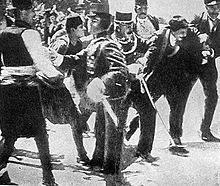
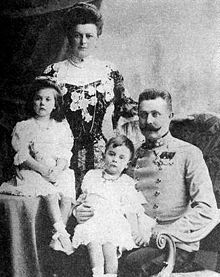
In  Eastern Europe, Austria and Russia each strove to profit from the slow disintegration of the Turkish Ottoman Empire. ‘Yugoslavia’ did not yet exist : the Balkans were a patchwork of independent or semi-dependent states aligned either with Austria or with Russia. Austria-Hungary had annexed Bosnia-Herzegovina in 1908 which angered ethnic Slavs and Serbs who would have preferred joining up with neighbouring Serbia, an independent state with strong ties to Russia. On June 28 1914, the anniversary of his wedding, the heir to the Austrian throne, Archduke Franz Ferdinand, was due to make a routine state visit to Bosnia to inspect the army.
By all accounts the underground nationalist organisation, the Serbian Black Hand, sort of IRA of the time, was behind the Sarajevo assassination attempt though it was actually carried out by six young volunteers, very much the sort of people who now become ‘suicide bombers’ in the Middle East. What is remarkable about the assassination (apart its unexpected world-wide consequences) is the way a series of ‘coincidences’ led, first of all to the total failure of the assassination, and, almost as an afterthought, to its equally unexpected success. The record of events reads more like the plot of a Peter Sellers comedy than a tragic drama.
To start with, once the Archduke and his wife had arrived at Sarajevo Railway Station, special security officers who were supposed to accompany their chief and take their place in the first car of the cavalcade somehow got “left behind” (Wikipedia). The six conspirators had been posted at intervals along the pre-arranged route which led from the railway station to the barracks and from there to the Town Hall. The first two conspirators,  both armed with bombs, did nothing, either because they lost their nerve or because of the unanticipated presence of the Archduke’s wife, Sophie, alongside him in the third car of the cavalcade. Further along the route, at 10.10 a.m., Čabrinović threw his bomb but it  bounced off the cover of the convertible into the street, wounding twenty bystanders but without even drawing blood from the Archduke. Čabrinović, provided in advance with a suicide pill, bit into it and, for good measure, threw himself into the Miljacka river nearby. However, the cyanide only induced vomiting and he didn’t drown either because there was hardly any water in the river – Wikipedia says it was “only five inches deep” !  The procession continued onwards to the Town Hall passing the last three conspirators who all, including Gavrilo Princip, failed to act.
The assassination attempt had thus proved to be a complete fiasco, rather like the Islamist terrorist attempt at Glasgow Airport three or four years ago. The Archduke, somewhat rattled but otherwise none the worse for wear, made a short speech at the Town Hall thanking the people for their support and evident joy that the plot had failed. The Archduke and Sophie cancelled the normal itinerary in order to visit the wounded at Sarajevo Hospital and once again got into the same convertible. Potiorek, the Governor of Sarajevo, ordered the cavalcade to travel to the hospital via the Appel Quay, the route the cavalcade had followed earlier  in the day, but seemingly ‘forgot’ (!!!) to inform the driver of the third car of this change of plan. Halfway there, the driver of the car containing the Archduke and his wife turned into Franz Joseph Street, quickly realised that he had lost the other cars and reversed. His engine stalled. Princip who still had his pistol in his rucksack, happened by some extraordinary chance to be at that very spot; he rushed forward knocking a  bystander out of the way and fired two shots from virtually point-blank range. The Archduke and his wife died from their wounds within the hour at Sarajevo Hospital. As for Princip, nineteen years old at the time, he was arrested, tried and sent to prison but could not be executed because of his age. He subsequently confessed that he had not wished to kill the Archduke’s wife.
The assassination, though unusual because of the high rank of the victim, would have soon been forgotten had it not led, in an incredibly short space of time (three months), to declarations of war between the major European powers. The event  is thus not so much remarkable in itself as remarkable because of its unintended consequences : the nebulous aim of the conspirators was certainly not to provoke a world war but merely to warn Austria to stop interfering in the affairs of the Balkan states.
Taleb mentions this event as an example of the ‘imponderables’ of history but it is not clear that it really qualifies as a ‘Black Swan’ event because it was deliberately planned. The assassination of Archduke Ferdinand had ‘extreme impact’ and was a (relatively) rare event but was not a random event in any sense of the word. It is the consequences that were unforeseen and arguably unforeseeable, not the event itself.
But wasn’t a general European war inevitable anyway ?  Marxist theory predicted a large scale conflict between the great capitalist powers looming up but Lenin was actually caught out by the outbreak of hostilities and was flabbergasted that the German Social Democratic Party voted war credits to the government. Historians are always ready with reasons after the event but nobody at the time seems to have explected war just then and A.J.P. Taylor argues that German industrialists in particular did not welcome war since they “were convinced, with good reason, that Germany would soon become the leading Power in Europe from sheer economic strength” (Note 1).
The four great powers, Britain, France, Germany and Russia had been eying each other warily for the last twenty odd years and several incidents had brought the countries to the brink.  Britain and France pursued a tortuous diplomatic path, unsure which was the greater threat, Germany or Russia. Indeed, the twentieth century could easily have gone the other way : instead of Germany fighting the other big European powers more or less single-handedly, a second possibility was everyone ganging up on Russia to stop its remorseless expansion westwards (Note 2). It is as if the dramatist of twentieth century history put in a subplot and for some time the audience was deliberately left in the dark as to which was the main plot and which the subplot. Britain’s alliance with Russia, Tsarist or Soviet, was  never anything but reluctant and, during the Thirties, a considerable section of the British public thought that Hitler had his uses as a bulwark against Communism. And, as it happens, the subplot just didn’t want to go away since during the latter part of the twentieth century there actually was an alliance of the big European countries including (West) Germany against Russia and this alliance did result in a ‘war’ of sorts, the ‘Cold’ variety.
Interestingly, a computer programme devised by Axelrod and Bennett using concepts such as the tendency of physical systems to seek out ‘potential minima’ has been applied to alliance formation in Twentieth century Europe. According to the programme, the two most likely scenarios are (or rather were) : all the big West European powers except Italy on one side and Germany and one or two smaller states on the other, or the whole of Europe except for Yugoslavia and Greece against Russia standing virtually alone (Note 3). The first scenario was the plot, the second the subplot.
It is now becoming fashionable for scientists to profess disbelief in free will and thus in personal responsibility — though if I actually knocked one of them down in the street he would be outraged and take me to court rather than view me as a victim of my genes or social circumstances. I personally take the commonsensical view that, although there are all sorts of contributing factors that influence human behaviour, nonetheless there is such a thing as free will. I don’t think the assassination  at Sarajevo was inevitable simply because it happened, and, more specifically, don’t think that it necessarily had to lead on to world war just because it did.
On the other hand, I certainly don’t think that ‘anything can happen any time’. In a particular historical situation there exist definite large-scale trends, not unlike Stock Market movements, but whether one particular trend leads to a specific outcome depends firstly on whether the political system is in a ‘critical state’ and, secondly, whether an unexpected stray event sets things off (or has the reverse effect of damping things down). This is more or less in line with contemporary thinking which increasingly stresses the importance of the dynamic interaction of a multitude of elements which can end up by pushing the system into a qualitatively different state. However, I am prepared to go rather further down the line than most rationalist/scientists would wish to go, terrified as they are of anything that smacks of elan vital or occult forces (as they see it). I believe that events and the forces that develop between events are the driving forces of history : human beings are in the curious position of being at one and the same time subject to the exact selfsame forces as everything else but simultaneously  capable, within circumscribed limits, of deciding which trend to follow or whether to retire from the action (Note 4).
So what exactly is going on in the Sarajevo assassination in terms of the youthful science of Eventrics (the study of event chains and their interactions)? We have an explosive event environment, Europe’s economic and political condition at the beginning of the twentieth century, but this has no direct bearing on the train of events in question, the ‘Sarajevo assassination’ event-chain, only on its unexpected  consequences. Curiously, the event that set Europe ablaze took place on the sidelines, in a “forgotten state whose name few people knew” and yet not far enough away to be insulated from the volatile European event- environment.
The ‘assassination’ event-sequence  gathers momentum, and several ‘coincidental’ circumstances strengthen it. The ringleader of the plot was a certain Ilic but he did not participate in the actual assassination. Three of the conspirators were Bosnian Serbs from Belgrade and they had to cross the frontier to enter Bosnia. The father of one of the three,  Čabrinović, had been a Sarajevo police official and  on the train to Sarajevo Čabrinović bumped into one of his father’s friends, Sarajevo Police Detective Ivan Vila, and struck up a conversation.  Čabrinović learned from Vila the date of Franz Ferdinand’s visit to Sarajevo and passed the news on to the others. It has been suggested that Potiorek, the Governor of Sarajevo, was complicit in the assassination attempt and certainly the security arrangements were very lax, but this is probably going too far though his strange behaviour suggests that he suspected something was going on.
At this point a contrary event-chain comes into operation. The first two conspirators do not act, perhaps because of the unexpected presence of a woman in the targeted car. Then there is the ludicrous incident of Čabrinovic’s bomb getting deflected and the failure of his attempted suicide (by two different methods). Finally, the last two potential assassins do not act either : maybe  they got wind of the failure of Čabrinovic or something in the general atmosphere unnerved them. The anti-assassination event-chain thus seems to have completely knocked out the first, so much so that the Archduke speaks of the ‘failed’ assassination plot just an hour or so before his actual death.
Even though the action was planned, its eventual success was the result of chance, of the highly unlikely convergence of at least three separate events : the driver of the car taking a wrong turning, the engine stalling at this precise moment and Princip’s fortuitous presence at exactly the right spot. Not only this, the attempt was much more likely to be successful in this case since Princip was able to approach the car without being challenged and was able to fire from a distance of five feet whereas, earlier on, the cavalcade passed at high speed. The chances were that a bomb thrown in the crowded street or a shot fired from the middle of a jostling throng of people would only have wounded the Archduke anyway, whereas, because of the fateful wrong turning, Princip was able to approach the statonary car and fire from close range, killing the Archduke with a single shot. The assassination event-chain thus ‘won out’ but in a very strange way : it actually turned to advantage the initial failure of the plot since no one was expecting a further attempt and, if the Duke had not departed from his initial itinerary, he would never have been right in front of Princip in a less crowded street.
Those who believe in fate might conclude that this assassination ‘had to be’ and nothing at all could have prevented it. I do not go so far as this, but I do see a certain interplay of event-chains that strikes me as being more than fortuitous. Of course, event-chains do not ‘know what they are doing’ when they are opposing each other in this way, but then neither do viruses and bacteria ‘know what they are doing’ when they struggle for supremacy.
So what is my conclusion — if not fate, then just bad luck ? I believe that events go through several stages before becoming actual, as it were  : the various possibilities ultimately narrow down to just one or two and a random interaction with a stray event can decide which event-chain is finally materialised (Note 5). The parallel in physics is a system which is in a state of unstable equilibrium. A needle balanced on a straw is likely to be toppled over at the slightest motion of the table and which way it falls depends on the disturbance. A marble in a hollow may be temporarily pushed up one side of an incline for one reason or another but will roll back down again.
This ‘Event Rehearsal’ theory could be used to explain certain alleged cases of precognition : it is not the actual event in the future that is seen but its approximate materialisation which is why even relatively successful ‘prophets’  get some details wrong.  It strikes me as ridiculous that scientists and rationalists prefer completely fantastic theories like the Many Worlds Interpretation (whereby all possibilities become actual in some world) rather than this relatively straightforward theory. Note that in the Event Rehearsal Theory there is a progressive actualization of events. In Quantum Mechanics we have two stages only  : a system left to itself consists of an infinity of possible events with differing probabilities whereas once another system (such as ourselves) interferes with it, the wave ‘collapses’ into a single unambiguous event. The problem, of course, with the Rehearsal Theory is determining where exactly all this ‘progressive actualization’ takes place but a similar problem exists for those, fairly numerous, persons who say they believe that the whole universe is a sort of vast computer carrying out simulations.     S.H. 
Notes :
(1) “Why did this [assassination] lead to a great war? Was some Power waiting only in the wings, or perhaps had already dfcided to start a war in August 1914 ? (…)  There was tension, of course, when five Great Powers faced each other in unbridled national sovereignty. This tension was no greater than in previous years. Germany and Britain were on more friendly terms, their naval rivalry dwarfed by agreement on the Baghdad railway and a future partition of the Portuguese colonies. France, too, was moving towards friendship with Germany. In April 1914 a general election in France had returned a pacific majority of Radicals and Socialists. (from A.J.P. Taylor, The First World War : An Illustrated History p. 15)    

(2) “Many people in England and France were more apprehensive of Russia than of Germany. Good judges guessed that bthe future pattern would be an alliance of the three Weste European Powers — France, Germany and Great Britain — against the Russian colossus” (A.J.P. Taylor, The First World War : An Illustrated History pp. 15-16)  

(3)  See Critical Mass by Philip Ball, pp. 354-361. Of course, the computer simulation got one or two details wrong — but it would frankly have been suspicious if it turned up exactly the right results. For example, Portugal is an ally of Germany in Scenario 1, and Poland is an ally of the anti-Russian Coalition in Scenario 2. In reality, Portugal and Spain, for ereasons of Realpolitik kept their distances from Hitler though preferring him to the French and British governments, and numerous volunteers from the Iberianm peninsula fought for the Reich.
As for Poland, it was only because Hitler invaded first that the Poles ended up technically ‘on the same side’ as Russia (Stalin invaded Eastern Poland six weeks later). If anything, the Poles at the time feared and disliked the Russians more than the Germans — there is the sick joke about a Pole being asked whom, given the chance, he would kill first out of a German and a Russian. He replied, “The German, Business before Pleasure”.

 (4) Market analysts are always advising traders to ‘go with the market’, rather than fight it. Unless you have the clout of George Soros, the  best strategy does indeed seem to be to ‘follow the trend’ rather than to seek to impose your own puny will on the market.
In general, it is not possible to operate directly on large-scale historic events : it is rather by operating on the connections between established or imminent event trends  that it is possible to acquire a certain ‘leverage’, but in the right context, this gives one a very significant advantage. Successful military and political leaders like Julius Caesar, Cromwell or Hitler were adept at ‘waiting upon events’ (the phrase is from Cromwell) and letting them do much of the work.

 (5)  It  is particular associations of ultimate events that become ‘progressively actual’ rather than the ultimate events themselves (the latter  have ‘no time’ to go through various stages of realisation). As I see it, ephemeral associations of events, perhaps lasting just a few chronons, take place incessantly and it is only after a kind of natural selection process that certain associations of events become dominant. The whole process is endlessly repeated on an increased scale culminating in the very large patterns we call historical events.
In Hinayana Buddhism one comes across the notion of different stages in the materialization of dharmas, some Indian authors going so far as to suggest that each dharma goes through as many as seventeen stages from original inception to complete realization.

It has always been my impression that ‘Space’Time’ is discontinuous, or, to be more precise, that what we perceive is necessarily discontinuous — I am slowly coming round to the view that there may be an underlying reality which is, if you like, ‘continuous’, the perceived reality being a sort of froth on the surface of this deeper reality. Our Western scientific viewpoint, partly because of the influence of Newton and his ‘Theory of Fluxioms’, has always favoured continuity. But now some physicists are seriously re-considering the matter.
“We often speak of the fabric of space, as if it were continuous, but is it instead a kind of patchwork of jittering quantized bits?” writes Mariette DiChristina, the editor in chief of  Scientific American (in February 2012 issue).
The Director of Fermilab Particle Physics Centre, Craig Hogan, is planning an experiment which may “change what we currently think we know about the nature of space and time” (DiChristina).
“According to Hogan, in a bitlike world, space itself is quantum — it emerges from the discrete, quantized bits at the Planck scale (Note 1). (…) It does not sit still, a smooth backdrop to the cosmos. Instead, quantum fluctuations make space bristle and vibrate, shifting the world around with it. “Instead of the universe being this classical, transparent, crystaalline-type ether,” says Nicholas B. Suntzeff, an astronomer at Texas A&M University, “at a very, very small scale, there are these little foamlike fluctuations. It changes the texture of the universe tremendously.”  from “Is Space Digital?”  by Michael Moyer, (Scientific American, February 2012).

Notes :  (1)  The term ‘Planck scale’ can refer either to a space or time scale. Planck time is about 5.39 × 10 (exp –44) secs and Planck length is about 1.6 × 10 (exp –35) metres  (from Wikipedia)

I first conceived the idea of the new ‘science’ of ‘Eventrics’ some thirty years ago. At the time, I had just come back from a long period abroad and one of the main reasons I returned to civilisation was to study mathematics (via the OU) — even though mathematics was a subject for which I had shown no aptitude at school and had always heartily detested. My aim in following this surprising course of action was to better understand the adversary — rather in the manner of certain Syrian or Persian princes who travelled to Rome to acquire a military education before returning to their countries to start a revolt.
However, the reverse happened : I found myself seduced by the elegance and power of the axiomatic mathematical method and, so to speak, went over to the enemy.  A little later, when I began pondering about events and their interconnections, I automatically started off in the manner of Euclid  by formulating certain  basic axioms and postulates (see earlier post) and tried to draw some conclusions from them. I soon saw that a new symbolic system was required and I did manage to concoct a somewhat cumbersome method of classifying event-chains according to certain criteria. I got more and more involved, not to say obsessed, with these speculations and spent most nights endlessly discussing Eventrics and related topics with the only person I saw anything of at the time, Marion Rouse, a true kindred spirit unfortunately now long deceased.
But the system obstinately refused to ‘take off’.  With hindsight I can now see that certain computer ‘systems’  such as ‘cellular automata’, being developed at this precise moment in America, were the sort of tools I needed and was groping towards — but these developments were still little known in Europe and anyway all this was taking place at a far more exalted scholastic level than mine. So the new science of ‘Eventrics’ never got off the drawing board and, although the idea remained at the back of my mind, it is only very recently that, after browsing through suitcases full of mildewed exercise books and clamp files, that I have finally decided to put some of this strange stuff into the public domain. As an arch-Luddite (by temperament anyway) I originally viewed the Iinternet as a deadly threat to humanity, but once I started using it, I found that the ‘bitty’ format of blogs exactly suited my style.
So far, so good. But nonetheless I still carried on assuming that if Eventrics was ever to come to anything, it would have to be thrown into a rigorous axiomatic mould with appropriate mathematical symbolism and so on and so forth. Two days ago, though, I had a sort of Eureka moment. The material was still refusing to do as it was told and I found myself drifting into a more informal presentation — encouraged by coming across Taleb’s book The Black Swan where the author lauds the merits of working ‘bottom up’ rather than ‘top down’ (1). Now, the key idea of Ultimate Event Theory is discontinuity : the theory completely breaks with the entire mathematic-physical Western tradition of continuity and infinite divisibility which still casts a long shadow over science even in this quantum era.  Surely, I said to myself,  the theory, since it is the study of radical discontinuity, should by rights be developed in a discontinuous manner. So it should ! I resolved to make no further attempt, at this stage in the game anyway, to throw the rapidly accumulating material into a mould where it clearly did not want to go.
What’s the alternative ?  To allow, or rather encourage, a theory to develop ‘organically’ as things do in the natural world : this approach is especially appropriate in this century now that biology has clearly taken over from physics as the leading science. Nature does not bother too much with mathematics — far, far less than mathematicians imagine — it proceeds  by trial and error, fits and starts, threshes around in all directions until something that works turns up (a new species). As a matter of fact most important human developments started off like this as well  : even the mechanical/mathematical revolution which culminated in Newton’s Mechanics evolved painfully over a period of at least three centuries with all sorts of people contributing the odd block to the growing edifice — who, today, has heard of Oresme or Horrocks for example ? The fully fledged Mechanical view of the world, perhaps the most successful intellectual paradigm to date, had to wait for the genius of Newton to gather all these disparate strands together into a mighty synthesis.
It is clear to me, and seemingly to a growing number of other people, that Western society is undergoing a new paradigm shift at the moment : something is painfully emerging from the welter of discordant and scarcely intelligible ideas spawned by the twentieth century. I believe that progress in understanding the world and our place within it will come, not from making the current mathematical and conceptual apparatus even more abstruse, but rather from ‘going back to basics’ and re-examining the basic concepts of physical science. Hopefully, my ideas concerning events and event-chains, naive though they inevitably are at the moment, will bear fruit somewhere sometime in someone’s head. I intend to open up the field, starting with what is inside my head  : I shall no longer try to fit  my ideas into a formal strait-jacket but let them come out pell-mell, though maintaining a certain spasmodic surveillance noentheless.
My strategy at the moment, inasmuch as I have one, is to itemise various snippets that I sense could be important, trusting to Providence that somehow (changing the metaphor) these paths through the scrub and wilderness will eventually converge and an oasis will be there in front of us. One of the basic assumptions of Ultimate Event Theory is that, once certain collections of heterogeneous events have developed cohesion, they will attract other events to themselves, leading to yet larger conglomerations : this is an entirely ‘mechanical’ process, pretty much independent of the people concerned or the precise nature of the events. Eventually (sic) a fully fledged theory will ‘emerge’ without any one person having deliberately created it : the principle being to ‘give events enough rope’,  either to hang themselves, or tie themselves into an elegant seaman’s knot. We will see whether and how soon this happens and who will join me in this venture into the (not entirely) unknown.

 Notes :  

(1) The terms ‘bottom up’ and ‘top down’ are Stockmarket trader jargon — Taleb, the author of The Black Swan was (and possibly still is) an options trader. Economists tend to work ‘top down’, i.e. they start with the theories and try to fit the facts to the theory; traders tend to use whatever methods they find work for them and  any ‘theory’ there may be is just a generalisation from actual experience. Western science, stemming as it does from the Greeks and given a strong philosophic impetus by Plato, started off as a largely ‘top down’ affair and, despite the emphasis on experiment and observation, this legacy is still very much with us, particularly in physics which has today become little more than a branch of (very abstruse) applied mathematics.


The test of a model depends on what it can predict, though this is not the only consideration : models which stimulate the mind because they are ‘intuitively clear’ have proved to be extremely helpful in the development of science even if they were eventually discarded.
Anyone wishing to lay the foundations for a new science on the basis of preliminary assumptions must steer a narrow course between two extremes. On the one hand, he must beware of wrenching unjustifiable conclusions from the premises because he ‘knows exactly where he wants to land up’. On the other hand, there is no point in threshing around in the dark and hoping for the best : once it is clear that one line of argument is leading nowhere, it must be abandoned. How do we know it is leading nowhere ?  Often we don’t, but we can appeal to our own or others’ experience to judge how we are progressing. For example, de Sitter’s model derived from Einstein’s Equations of General Relativity was clearly wrong (or rather not applicable to the case that concerned us) since it predicted a universe completely empty of matter. In other cases, early scientists were eventually proved ‘right’ (though not necessarily for the reasons they believed at the time), for example Huyghens’ wave theory of light.

        I shall attempt to avoid these two extremes. My sketchy knowledge of advanced physics and current experimentation (HLC and so on) could actually be an advantage in the sense that I am by no means sure ‘where I want to land up’, so I am less likely to fudge things. As for the second danger, a manifestly absurd conclusion will (hopefully) prompt me to re-examine my original assumptions and add to them, and, if this does not work, simply admit that something has gone wrong. But at this stage in the game it would be unfair to  expect, and even foolish to desire, anything but the broadest qualitative predictions : being too specific in one’s forecasts too early can all too easily block off diverging avenues worth exploring.

Before drawing any conclusions, I will briefly review in an informal manner, the preliminary assumptions on which the whole of Ultimate Event Theory is based. Broadly speaking, In a nutshell, I consider that “the universe is composed of events rather than things”. Although I have listed some properties of ‘events’ as I see them, at this stage I have to assume that the notion of an ‘event’, or at any rate the distinction between an event and a ‘thing’,  is ‘intuitively clear’. Ultimate events associate together to form ‘ordinary’ events but cannot themselves be further decomposed — which is why thet are called ‘ultimate’. They occupy ‘spots’  on the ‘Locality’ — the latter beihng, for the moment, nothing more than a  sufficiently large expanse able to accommodate as many ultimate events as we are likely to need. Ultimate events are ‘brief’ : they flash into and out of existence lasting for the space of a single ‘chronon’, the smallest temporal interval that can exist, in this ‘universe’ at any rate. A definite ‘gap’ exists between successive appearance of ultimate events : physical reality is discontinuous through and through (Note 1). Some ultimate events acquire  what I call ‘dominance’ : this enables them to repeat identically, perhaps  associate with other stabilized ultimate event and influence event clusters. ‘Objects’, a category that includes molecules and some elementary particles (but perhaps not quarks) — are viewed as relatively persistent, dense event-clusters. Dominance is not conserved on the grand scale : there will always be some ultimate events that  pass out of existence for ever, while there are also ultimate events which come into existence otherwise than by a causal process (random events) (Note 1).

The predictions are as follows:

(1)  There will always be an irreducible background ‘flicker’   because of the discontinuity of physical reality. This ‘rate of existence’ varies : essentially it depends on how many positions on the Locality are ‘missed out’ in a particular event-chain. The rate of most event chains is so rapid that it is virtually imperceptible — though, judging by certain passages in the writings of Plato and J-J Rousseau, some people seem to have thought they perceived it.  But there should be some ‘extended’ event chains whose flicker can be recognized by the instruments we now have, or will shortly develop (Note 2).

(2)  The current search for ‘elementary particles’ will turn up a very large quantity of heterogeneous ‘traces’ which are too brief and too rare to be dignified with the title of ‘elementary particle’.  The reason for this is the vast majority of ultimate events do not repeat at all : they flash into existence and disappear for ever.

(3)  The number of ‘elementary particles’ detected by colliders and other instruments will increase though some will never be detected again : this is so because ultimate events are perpetually forming themselves into clusters but also  ‘breaking up’ into their component parts, in some cases dematerializing completely.

(4) Certain ‘elementary particles’ will pass clean through solid matter without leaving a trace : this will tend to occur every time the (relative) speed of a very small event cluster is very large while  and the ‘thickness’ of the lumped cluster is small in the direction of travel (Note 3).

(5)  There will always be completely new event-clusters and  macroscopic events, so the future of the universe is not completely determinate. This is so because not all ultimate events are brought into existence by previously existing ones : some ultimate  events originate not in K1 (roughly what is known as the physical universe) but in K01 , the source of all events. If these ‘uncaused events’ persist, i.e. acquire self-dominance, or come to dominate existing event clusters, something completely new will have come into existence —  though whether it persists depends on how well it can co-exist with already well-established event-clusters. In brief, there is an irreducible random element built into the universe which stops it being fully determinate.

Notes :

(1) Since putting up this post on January 18th, I have come across what might be confirmation (od a sort) of this prediction. The February 2012 edition of Scientific American includes a mind-blowing article, Is Space Digital? by Michael Moyer. “Craig Hogan, director of the Fermilab Center ….thinks that if we were to peer down at the tiniest subdivisions of space and time, we would find a universe filled with an intrinsic jitter, the busy hum of statuc. This hum comes not from particles bouncing in and out of being or other kinds of quantum froth that physicists have argued about in the past. Rather Hogan’s noise would come about if space was not, as we have long assumed, smooth and continuous, a glassy backdrop to the dance of fields and particles. Hogan’s noise arises if space is made of chunks. Blocks. Bits.”  This is not just a passing thought, for Hogan “has devised an experiment to explore the buzzing at the universe’s most fundamental scales.”
I originally thought that what I call the ‘flicker of existence’ would remain forever beyond the reach of our instrumentation and said as much in the original draft of this post. However, after thinking about the amazing advances made already, I added, perhaps prophetically, “There should be some ‘extended’ event chains whose flicker can be recognized by the instruments we now have, or will shortly develop.”  Maybe Hogan’s is one of them.
However, I do not ‘buy’ the current trend of envisaging the universe as a super computer  — for Hogan my ‘flicker of exietence’ is  ‘digital noise’. The analogy universe/computer strikes me as being too obviously rooted in what is becoming the dominant human activity — computing. I wouold have thought the ‘universe’  had better things to do than just process information. Like what for example ?  Like bringing something new into existence from out of itself, actualizing what is potential. In a nutshell : the ‘universe’ (not a term I would choose) is creative not computational. But I suppose one cannot expect trained scientists to see things in this light.    S.H. (7/2/12)

(2) Heidegger put it more poetically, “Being is shot through with nothingness”.

(3)   This happens because a rapid event cluster ‘misses out’ more event locations on its path, so the chance of the two clusters ‘colliding’, i.e. ‘competing’ for the same spots on the Locality, is drastically reduced.

(4) This is so because not all ultimate events are brought into existence by previously existing ones : some ultimate  events originate not in K1 (roughly what is known as the physical universe) but in K01 , the source of all events. If these ‘uncaused events’ persist, i.e. acquire self-dominance, or come to dominate existing event clusters, something completely new will have come into existence —  though whether it persists depends on how well it can co-exist with already well-established event-clusters. In brief, there is an irreducible random element built into the universe. (This is quite apart from Quantum Indeterminacy which in any case would disappear if a coherent ‘hidden variables’ theory replaces the orthodox one.)

I will discuss in a subsequent post whether modern experiment and observation gives any support to these predictions.

(Note: This is not a review of the best-selling book, The Black Swan, The Impact of the Highly Improbable, by Nassim Nicholas Taleb : I shall merely discuss its relevance to the practical side of ‘Eventrics’.  S.H.)

The chief drawback of this otherwise very interesting and insightful book, The Black Swan, is that it is too negative.  It tends to focus on catastrophic Black Swan events and argues that such events are strictly unpredictable, inherently so, not just because we lack the necessary information or computing power. In my own lifetime I have witnessed incredible turnanouts that strictly noone saw coming, the sudden collapse of communism in Eastern Eureope, the advent of the Internet, 9/11, the financial meltdown of 2008, the sudden emergence of China as the 21st century’s superpower, the list is endless. I was personally a witness of the May 1968 ‘Student Revolution’ when a scuffle between students and the police in the Sorbonne rapidly led on to a general collapse of law and order and the longest General Strike in a Western country during the 20th century. The amazing thing was that all the Left (and Right) political groups and parties didn’t know whether they were coming or going : this was an entirely unforeseen and above all spontaneous movement emerging from nowhere (Note 1).
For these and other reasons, I had no difficulty in agreeing with Taleb’s main  thesis that history moves by jumps, not small steps, and that the big jumps are caused by events few people, if any, predicted, by what he calls ‘Black Swan events’. [To recap : a Black Swan event is an event that is rare, sudden, unexpected and has extreme impact).
But what about one’s personal life? Can anything be done about Black Swan events, the unpredictables of life, apart from getting out of the way when they start looming up and you don’t like the look of them ? That Taleb thinks something can be done is shown by the uncharacteristic aside made on p. 206 “As a matter of fact, I suspect that the most successful businesses are precisely those that know how to work round inherent unpredictability and even exploit it“.  I entirely concur with this, except that I would remove the word ‘even‘.
In the active professions (business, warfare, invention, living  by your wits, staying alive when you should be dead &c,), it is essential not only to fully recognize the role of the unexpected but to be prepared to turn it to one’s (apparent or real) advantage.  This is an extremely difficult skill that may need a lifetime of practice but it is worth learning because it can lead to outcomes that  otherwise would be unthinkable  — this is why it is called ‘Not-Doing’ in the Tao Te Ching , to distinguish it from ‘Doing’ which requires the use of force and/or intellect.
The “modest tricks” (Taleb’s term) that Taleb has gleaned from his life as an option trader and sceptical observer of humanity are given on pp. 206-11 of his book, The Black Swan (Penguin edition). The key principle which may be called Taleb’s Wager derived from Pascal’s rather dubious ‘wager’ concerning the existence of God, goes as follows :
“I will use statistical and inductive methods to make aggressive bets, but I will not use them to manage my risks and exposures.”
Taleb, Fooled by Randomness p. 130

I am not sure that this principle  quite follows  from the author’s basic principles, it sounds more  like a ‘rule of thumb’, the sort of thing Taleb in other contexts tends to look down on since Taleb has little time for instinct and ‘gut reactions’. But the logical argument seems to go something like this :
“It makes sense to use conventional wisdom when calculating likely positive outcomes because the conventional economic wisdom works (up to a point) if we entirely disregard the possibility of potent unexpected events, Black Swans. Now, if a Black Swan event is fortunate (for us) we don’t need to take it into account because it will happen when and if it will happen : all we need to bother about is the everyday events which are, up to a point, predictable. But the reverse applies to an unfortunate Black Swan : we can’t stop it, no one can say when and if it will strike, so the best thing to do is cover ourselves against such an occurrence and completely disregard received opinion in the matter because it almost always discounts such events.”
The ensuing ‘life-strategy’ is to ‘make oneself available to fortunate Black Swans’ while ‘covering one’s defences against unfortunate ones’ e.g. by having a Plan B, not putting all one’s eggs in one basket and so on. Taleb claims that “all the surviving traders I know seem to have done the same …..They make sure that the costs of being wrong are limited (and their probability [i.e. the probability of the unfortunate Black Swan events S.H.] is not derived from past data)” (op. cit.).
Taleb’s Wager seems to have worked in his particular case. He tells us at one point, without giving the details, that he made a substantial amount of money during the shock 1987 Wall Street ‘Black Monday’ crash and he has also succeeded in publishing a  book which turned out to be a best-seller without any prior literary credentials — no small feat given the exclusiveness and current jitteriness of the  publishing industry.
    How do you get yourself into a position of ‘maximum exposure’ to positive Black Swans ? Well, one way is via chance encounters in bars which is how  James Dean and Rock Hudson got ‘spotted’ —  Rock Hudson was a truck-driver at the time.) Consequently, according to Taleb, it is advantageous to live in (or at least assiduously frequent) a big city because serendipitous chance encounters are much more likely to happen there. It also pays to ‘go out’ : as he remarks, diplomats, a fortiori spies, know the rich spoils to be had from hosting or attending parties. But even more bread-and-butter professionals should take note : “If you’re a scientist, you will chance upon a remark that might spark new research” . Learned societies, including the Royal Society itself, were originally informal get-togethers of enthusiastic amateurs and often took place in inns; Paris owed its central cultural (and political) position for two whole centuries not so much to its progressive educational system as its unique cafe ambiance. You could still see Sartre sipping coffee at Les Deux Magots on occasion when I first hit the Boulevard Saint-Germain and Cocteau recounts meeting at La Rotonde, a cafe I used to frequent, a funny little man with a pointed beard who, when asked what he wanted to do in life, replied, to general hilarity, that he was trying to bring down the Russian government — it was Lenin.
A point not mentioned, I think, by Taleb is that a negative Black Swans, if it doesn’t completely finish you off completely, can morph into a positive one : losing a battle could make you seriously revise a defective strategy, dismally failing to make a go as a commercial traveller might propel you into a less lucrative but much more satisfying profession. Even one might hazard the guess that a Black Swan turned on its head so to speak is more effective than a straightforward fortunae Black Swan. Steve Jobs lost the fight with Bill Gates over PCs but this prompted him to move into mobile phones, iPods and so on : the result is that Apple is, so I have been told, currently rated as an even bigger licrative company than Microsoft. Hitler transformed the complete fiasco of the BeerHall putsch into a resounding success using his appearance in court as a  way to broadcast his poisonous views to the nation, and it is said that it was to prevent this happening again that the Marines were told not to take Bin Laden alive.
Another useful tip from Taleb is not to be too precise about the sort of positive Black Swan you’re looking for. Since Black Swan events are by definition unexpected, they will appear in unexpected disguises — even, or above all, to those who are out hunting for them.
Certain other pieces of advice, especially those relating to probability and ‘rational decision-making’ I find a good deal less useful : they may be of value on Wall Street but not in the sort of places I’m used to frequenting. The entire apparatus of traditional logic, ‘straight thinking’, probability theory, even mathematics, is almost completely irrelevant to the hurly-burly of ‘real life’ which is one reason why so many people with little formal education e.g. Edison, Bill Gates and Richard Branson have been spectacularly successful in business. Mathematics creates a (virtually) foolproof little world closed off to the exterior : this is its strength, sometimes beauty, also its hopeless limitation. In real life, you generally have totally inadequate, even untrustworthy data, and there is no time to fit the data to equations, no time to quantify what you’ve got in front of you. You have to make quick qualitative decisions — exactly what mathematicians and logicians spurn — sign or don’t sign that document, fight or flee if you’re attacked in the street. ‘Rules of thumb’ based on experience are a good deal more use out in the real world than training in formal logic. Amusingly, someone I knew who worked in information technology told me that his firm does not welcome mathematicians, is indeed rather wary of them. The reason is not hard to guess : used as they are to perfectly well set-up situations, they are flummaxed by the unexpected and are no better at everyday decision-making than other people, often worse.
But betting on your own life’s best option is completely different to betting on the Stock Exchange. Why? For a start (as Taleb mentions in passing), in most professions you pay for your bad business decisions because the money’s your own and this clarifies the mind (or alternatively destabilizes it). Traders don’t, the big fish anyway, since even if they fail lamentably, they exit with golden handshakes.  But, even laying this aside, there are several other differences. On the Stock Exchange, a single action of a single individual, unless he is Warren Buffet or Geroge Soros, will not have much effect; however, in one’s own personal life, a single decision at a decisive point may count for more than years of effort. Retrospectively — though usually not prospectively — one sees certain key choices sticking out like signposts. Again, there is in real life no objective standard, no Moody publishing objective commercial ratings since one man’s wine may be another man’s poison.
Real life Black Swan situations also have a complication which seemingly does not apply to the Stock Exchange or the Board Meeting (though maybe it does after all) : at the beginning it is almost impossible to distinguish between a very favourable and a very unfavourable occasion, a negative or a positive Black Swan. Not only do you have to learn to deal with the unexpected, but must learn to cope with not knowing into which category the event cluster you find yourself committed to falls. Is the charming man or woman you have just met, and whom you feel you know so well already after only twenty minutes, going to be the person who will waft you out of obscurity to fame and fortune (if that’s what you want) or maybe tell you an important secret about the meaning of life? Or is he/she simply a confidence trickster or, which is almost as bad, someone who’s going to almost deliberately put you on the wrong track ?  In the fascinating but lethal hothouse habitat of big cities, it  pays to hone your ability to sum people up quickly and accurately : Richard Branson is on record as saying that he sums up a potential customer in the first two minutes and has rarely had reason to regret his verdict. It is also important, in many present-day chance encounters,  to be ready to run away if and when things turn nasty (fleeing is usually safer than fighting).
Taleb does mention an important defence stratagem : setting in advance for yourself a “cut-off point”, the moment when you will stop lending someone more money, (or stop asking someone for more and so lose him as a friend, which is more difficult to practice). “[In trading circles] this is called a ‘stop loss’, a predetermined exit point, a protection from the black swan. I find it rarely practised.” (Taleb, Fooled by Randomness p. 131).
Personal human situations are, anyway, very different from the complex physical systems such as the weather studied by chaos theory and complexity theory : there is a further layer of complexity added on since human beings are at one and the same time players and  observers, are inside the game and on the side-lines. They can in theory, if not in practice, “learn by their mistakes”. This happens in nature as well, of course, but the time-scale is rather longer — for a species it might be millions of years.
I disagree with Taleb’s strictures against what he calls the ‘narrative fallacy’, the tendency of human beings to jump to the conclusion that “where there is pattern, there is significance”.  This faculty doubtless has deep evolutionary origins : it goes back to the days when it was essential to interpret rapidly scarcely perceptible visual or auditory patterns which might well betray the proximity of a predator. Even on the cultural/intellectual level, pattern interpretation on the grand scale, though fraught with danger, has been incredibly productive even when it has turned out to be quiye misguided : scarcely anyone today believes in Plato’s, on the face of it, fantastic doctrine of Eternal Forms  but the approach has been extremely useful in the development of science — the very concept of an ‘ideal gas’ is thoroughly Platonic.
In any case, fom the point of view of Ultimate Event Theory, even ‘meaningless’ transitory patterns are significant since they are the result of ephemeral associations and dissociations of events :  the point is not whether these patterns are ‘spurious’ or ‘real’ — everything that has occurrence is real — but  whether they persist or not. Mandelbrot, who, like Taleb, warns against seeing significant patterns in financial price shifts says more than he realizes when he remarks that such changes “can be persistent, meaning that they reinforce each other; a trend once started tends to keep going. (…) Or they can be amti-persistent, meaning they contradict each other; a trend once begun is likely to reverse itself” (Mandelbrot, The(Mis)Beahviour of Markets p. 245). From my point of view, what this shows is that there are varying hidden forces of consolidation and dispersion at work, not unlike the tiny electro-magnetic forces between molecules in a gas (Van des Waals forces). It is strange that, although many writers are quite prepared to view the ‘market’ as a ‘living system’ not unlike a bacterial colony, no one seems prepared to view the components of such a system, events, as in some sense ‘alive’. But it is these myriad independent events, decisions, forecasts, sales &c. which direct everything and which, when and if they come together and act in unison cause a boom or a crash.
A more serious limitation of Taleb’s nonehtless excellent book is that he tends to view human beings as essentially passive victims of the unforeseen rather than as deliberate activators of change. You do not have to just sit waiting for a fortunate event to happen : you can sometimes deliberately put yourself in the way of a likely Black Swan event or even manufacture one deliberately, a technique which I call ‘Doing the Opposite’. If you are naturally an orderly, rational sort of person, do something wild and completely out of character like the woman who, after working in the City for many years, rowed single-handed across the Atlantic (Note 2) ; if you are naturally a spontaneous and romantic person, enrol for a course in calculus or Business Studies, you might even find you enjoy it. Such an unexpected course of action administers a severe shock to the system and, if it recovers (which is usually does), you will find yourself thoroughly invigorated.
Do I practice what I preach on this last point ? Pretty much. Last year, to the stupefaction of everyone who knows me, including myself, I suddenly decided to buy a ticket I couldn’t really afford to travel for the first time to a country that has always repulsed me (America), using a form of transport I disapprove of (air),  in order to engage in an activity I detest (trying to flog some of my work to strangers) in an environment I’d been warned I would absolutely loathe (Hollywood). I didn’t land an option with Warner Brothers but I view this decision as one of the most fruitful I’ve ever made in my life simply for the experience, and even plan going back for more punishment this year. (Actually, contrary to their reputation, I found almost everyone I met in LA charming and parts of downtown Los Angeles hauntingly beautiful, choc-a-bloc with the most incredible Art Deco buildings slowly crumbling into the dust, the whole area  suffused with the faded glamour of  the lost Golden Era of Los Angeles, the Twenties.)   S.H.

Notes :  (1) My reminiscences of these events, under the title Le Temps des Cerises : May ’68 and Aftermaths, have been published in The Raven, Anarchist Quarterly, Vol. 10 Number 2 Summer 1998

(2) “In 2005 Roz Savage became the first solo woman to compete in the Atlantic Rowing Race. She set out from the Canaries to row 3,000 miles alone and unsupported, and eventually arrived in Antigua after 103 days alone at sea.
What really intrigued me about her story was the process that led to her embarking on this extraordinary adventure. (…) After University, she followed a typical career path working her way up the corporate ladder, firstly as a Management Consultant and then moving on to be an Investment Banker. (…) In her early thirties, she started to get a niggling feeling that something was missing and that perhaps ther was ‘more to life than this’ ”  
From 52 Ways to Handle It, by Annabel Sutton (Neal’s Yard Press 2007)

S.H.